Discover the fascinating story behind Tower Bridge, from political battles and engineering innovation to construction challenges and Victorian ambition. Explore how London’s most iconic bridge was built and the people who made it possible.


Host: Hazel Baker
Hazel is an active Londoner, a keen theatre-goer and qualified CIGA London tour guide.
She has won awards for tour guiding and is proud to be involved with some great organisations. She is a freeman of the Worshipful Company of Marketors and am an honorary member of The Leaders Council.
Channel 4: The Orient Express: A Golden Era of Travel (Episode 1). Channel 5’s Walking Wartime Britain(Episode 3) and Yesterday Channel’s The Architecture the Railways Built (Series 3, Episode 7). Het Rampjaar 1672, Afl. 2: Vijand Engeland and Arte.fr Invitation au Voyage, À Chelsea, une femme qui trompe énormément. Yesterday Channel / UKTV Play: The Architecture the Railways Built (Series 3, Episode 7). Yesterday Channel / UKTV Play: Secrets of the London Underground (Series 3, Episode 2) and Secrets of the London Underground (Series 4, Episode 10). NPO (Netherlands): Het Rampjaar 1672 – Afl. 2: Vijand Engeland. Arte France: Invitation au Voyage – À Chelsea, une femme qui trompe énormément
00:00 Introduction to Tower Bridge
01:00 Why London Needed a New Thames Crossing
03:00 The Engineering Challenge
05:00 Early Designs and Political Battles
06:00 Choosing the Bascule Design
06:30 Horace Jones and John Wolfe Barry
08:00 The Tower Bridge Act of 1885
09:15 Delays and Construction Planning
10:00 Building the Foundations
12:00 The Six Divers of Tower Bridge
14:00 Building the Steel Structure
16:00 The Hydraulic Mechanism
18:00 Victorian Engineering and Safety
19:15 Operating Tower Bridge
20:00 Costs, Delays, and Budget Overruns
21:15 Deaths and Dangers During Construction
22:00 Legal Disputes on the Thames
24:15 How Construction Changed the River
24:45 Critics Versus the Public
27:30 The Grand Opening of 1894
28:15 Honouring the Workforce
29:00 The Legacy of Tower Bridge
29:45 Closing Thoughts and Further Listening
Tower Bridge may be one of London’s most recognisable landmarks today, but its construction was far from straightforward. The bridge emerged after decades of political disputes, engineering debates, public pressure, and competing interests, all against the backdrop of a rapidly growing city.
By the 1870s, East London had expanded dramatically, with vast numbers of people dependent on trade, industry, and transport. Yet there was no crossing east of London Bridge. Increasing congestion created urgent demands for a new crossing, while the busy shipping lanes of the Pool of London made any solution exceptionally challenging.
This episode explores:
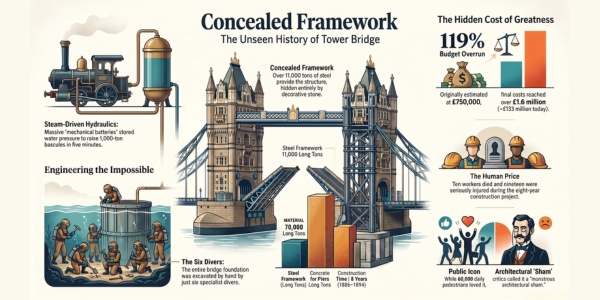
Concealed Framework of Tower Bridge | Infographic, London Guided Walks
The story of Tower Bridge is also the story of a remarkable collaboration between architect Horace Jones and engineer Sir John Wolfe Barry.
The episode follows the evolution of the bridge’s design, from Jones’s ambitious Gothic vision to Barry’s practical engineering solutions that allowed ships to pass while maintaining a road crossing across the Thames.
Topics covered include:
One of the most extraordinary aspects of the project was the construction of the bridge’s foundations beneath the River Thames.
Using enormous caissons sunk sixty feet below high-water level, workers excavated the riverbed to create what were reportedly the largest bridge pier foundations in the world at the time.
Special attention is given to the six divers whose work made the foundations possible:
Working in dangerous conditions with Victorian diving equipment, these men spent years excavating beneath the river and are commemorated by plaques within Tower Bridge today.
This episode takes a detailed look at Tower Bridge’s original operating system, one of the greatest engineering achievements of the Victorian era.
Listeners will discover how:
The episode also examines how the system was designed with extensive safety measures, influenced by lessons learned from the Tay Bridge disaster.
Tower Bridge was originally expected to cost £750,000 and be completed within four years.
Neither target was achieved.
The project ultimately required multiple Acts of Parliament to extend construction deadlines, while the final cost rose to more than double the original estimate once compensation payments, legal costs, and associated expenses were included.
The episode explores:
During construction:
These losses are examined within the wider context of Victorian industrial practices and workplace safety standards.
The construction of Tower Bridge also produced unexpected legal consequences.
The episode examines two fascinating court cases that reveal how the building works affected navigation on the Thames and altered the river’s behaviour.
These cases highlight:
Today, Tower Bridge is one of London’s most admired landmarks. However, many contemporary architectural critics viewed it very differently.
The episode explores the fierce criticism directed at the bridge by leading architectural commentators, who argued that modern engineering had been disguised beneath an artificial Gothic façade.
Critics described the bridge as:
The discussion explores why these criticisms emerged and why public opinion differed so dramatically from professional architectural opinion.
Tower Bridge officially opened on 30 June 1894 during a major ceremonial event attended by Edward, Prince of Wales (later King Edward VII), and Alexandra, Princess of Wales.
The episode concludes with the story of the opening celebrations, including:
Tower Bridge remains one of London’s defining landmarks, but its story extends far beyond architecture.
It is a story of:
Drawing on contemporary newspaper reports and Victorian sources, this episode reveals how Tower Bridge became one of the nineteenth century’s most remarkable infrastructure projects and an enduring symbol of London.
Listen to Episode 162 – “Building Tower Bridge” on the London History Podcast to discover:
Interested in discovering London’s remarkable engineering achievements in person?
Join Hazel Baker and London Guided Walks to explore the stories behind London’s bridges, rivers, markets, transport systems, and historic landmarks.
🎟 Book public walks or private tours:
londonguidedwalks.co.uk
🎧 Related Podcast Episodes: