Explore Victorian London below stairs in Episode 161 of the London History Podcast, uncovering the systems and servant labour that kept grand households running. From coal holes and mews to bell systems and strict hierarchies, discover how an unseen workforce shaped the city’s everyday life.


Host: Hazel Baker
Hazel is an active Londoner, a keen theatre-goer and qualified CIGA London tour guide.
She has won awards for tour guiding and is proud to be involved with some great organisations. She is a freeman of the Worshipful Company of Marketors and am an honorary member of The Leaders Council.
Channel 4: The Orient Express: A Golden Era of Travel (Episode 1). Channel 5’s Walking Wartime Britain(Episode 3) and Yesterday Channel’s The Architecture the Railways Built (Series 3, Episode 7). Het Rampjaar 1672, Afl. 2: Vijand Engeland and Arte.fr Invitation au Voyage, À Chelsea, une femme qui trompe énormément. Yesterday Channel / UKTV Play: The Architecture the Railways Built (Series 3, Episode 7). Yesterday Channel / UKTV Play: Secrets of the London Underground (Series 3, Episode 2) and Secrets of the London Underground (Series 4, Episode 10). NPO (Netherlands): Het Rampjaar 1672 – Afl. 2: Vijand Engeland. Arte France: Invitation au Voyage – À Chelsea, une femme qui trompe énormément
Timestamps:
00:00 Introduction to “Life Below Stairs” and Victorian servant London
02:00 The scale of domestic service in Victorian Britain
05:00 Soot, coal fires, and the need for constant household labour
08:00 The servant hierarchy: butler, housekeeper, cook, and below stairs roles
11:00 Rules of invisibility and servant discipline in the Victorian home
14:00 The architecture of separation: area steps and back entrances
17:00 Coal holes, delivery systems, and underground storage
20:00 The servant bell system and household communication networks
23:00 The mews: stables, coachmen, and working life behind grand houses
27:00 Case studies of surviving mews and working streets in London
30:00 Shepherd Market and the servant supply economy
34:00 A day in the life of a Victorian domestic servant
38:00 Downton Abbey vs historical reality of servant life
41:00 Sexual vulnerability and structural inequality in service
46:00 Why people entered and stayed in domestic service
48:00 18 Stafford Terrace and preserved Victorian household life
51:00 The dual city: upstairs vs downstairs London
54:00 Closing reflections on seeing Victorian London today
Life Below Stairs: Victorian Servants and the Hidden Machinery of London
In this episode, we explore the hidden world of Victorian domestic service, revealing the vast “below stairs” system that powered London’s grandest and most ordinary homes. From coal fires and soot-filled streets to bell systems and back entrances, the episode uncovers how Victorian households relied on an unseen workforce to maintain the appearance of effortless elegance.
The discussion builds a vivid picture of how servant labour shaped not only homes but the entire urban fabric of London, from architecture to social hierarchy.
The Scale of Domestic Service and Industrial London
The episode begins by setting out the enormous scale of domestic service in 19th-century Britain, where millions of women worked in households across the country. Domestic service is shown as the largest employment sector for women, far exceeding factories and mills.
It explains how coal-driven pollution made constant cleaning essential, with soot settling on every surface and requiring relentless labour to maintain the appearance of cleanliness and order.
The Hierarchy and Structure of Servant Life
The conversation moves into the strict hierarchy of Victorian households, from butlers and housekeepers to cooks, housemaids, and scullery maids.
Outlines:
- The division between male and female staff roles
- The authority of the cook and senior servants
- The exhausting conditions faced by lower servants
- The mews staff, including coachmen and grooms
This section highlights how domestic service operated as a rigid and formalised system with clearly defined ranks and expectations.
Invisibility, Rules, and Architectural Separation
A key theme is the enforced invisibility of servants, reinforced through strict behavioural codes and architectural design.
- Servants using back stairs and separate entrances
- Rules of silence and non-engagement with employers
- The removal of personal identity through recycled servant names
- The social expectation that servants should remain unseen
This invisibility is mirrored in the physical structure of London homes, where grand facades concealed complex service systems behind them.
Area Steps, Coal Holes, and the Hidden Infrastructure of London
The episode then explores the built environment that supported servant labour.
- Area steps leading to basement kitchens
- Coal hole covers embedded in pavements
- Underground coal storage and manual transport
- The physical burden of carrying coal through houses
These features are still visible in areas like Belgravia and Mayfair, revealing the hidden systems that sustained Victorian life.
The Servant Bell System and Household Communication
The discussion moves to the bell systems installed in Victorian homes, which allowed communication between upstairs and downstairs.
- Wire systems connecting rooms to kitchens
- Distinct bell tones indicating different rooms
- The evolution into electric indicator systems
- How servants learned to recognise bells by sound alone
This section highlights how technology reinforced hierarchy while making labour more efficient but still invisible.
The Mews: Working London Behind the Streets
The episode explores the mews areas behind grand houses, where horses, carriages, and working-class staff lived and worked.
- Stable yards and coachmen’s quarters
- Harsh living conditions in cramped spaces
- The transformation of mews into desirable housing today
- Surviving examples such as Hyde Park Gardens Mews and Bathurst Mews
These spaces reveal the working backbone of elite London life.
Shepherd Market and the Servant Economy
The episode discusses:
- Butchers, bakers, and trades supplying grand households
- Servants acting as intermediaries in household economies
- Informal networks of gossip, jobs, and employment
- A parallel commercial world supporting Mayfair’s elite homes
A Day in the Life of a Victorian Servant
A detailed reconstruction of daily life shows the exhausting routine of domestic workers.
- Early morning fires and cleaning
- Long hours of physical labour
- Strict hierarchy in meal times and duties
- 17-hour working days with minimal rest
This section emphasises the relentless nature of domestic service.
Popular Culture vs Historical Reality
The episode critiques modern portrayals such as Downton Abbey and Upstairs Downstairs, noting how they soften the physical and emotional realities of servant life.
- The absence of physical exhaustion in dramatizations
- Idealised employer-servant relationships
- Historical testimonies that reveal harsher realities
Sexual Vulnerability and Structural Inequality
A difficult but central part of the episode addresses the vulnerability of female servants.
- Lack of legal protection or employment rights
- Dependence on employer references
- Risks of exploitation within the household
- Consequences such as dismissal, poverty, and social exclusion
This section emphasises systemic power imbalance within domestic service.
Why People Entered Domestic Service
The episode explains why so many still chose domestic service despite its hardships.
- Factory and industrial labour conditions
- Street poverty and instability
- Domestic service as relatively secure and “respectable” employment
Service, though harsh, offered shelter, food, and stability compared to alternatives.
18 Stafford Terrace: A Preserved Victorian Home
I introduces 18 Stafford Terrace as a rare surviving example of a Victorian household.
The episode highlights:
- Contrasts between richly decorated family rooms and plain service areas
- The preserved kitchen, scullery, and basement spaces
- Physical remnants of bell systems and servant infrastructure
The Dual City of Victorian London
The episode concludes with the idea of London as a “dual city”:
- Above: elegant, polished, public-facing architecture
- Below: hidden systems of labour and service
- A city designed around separation and invisibility
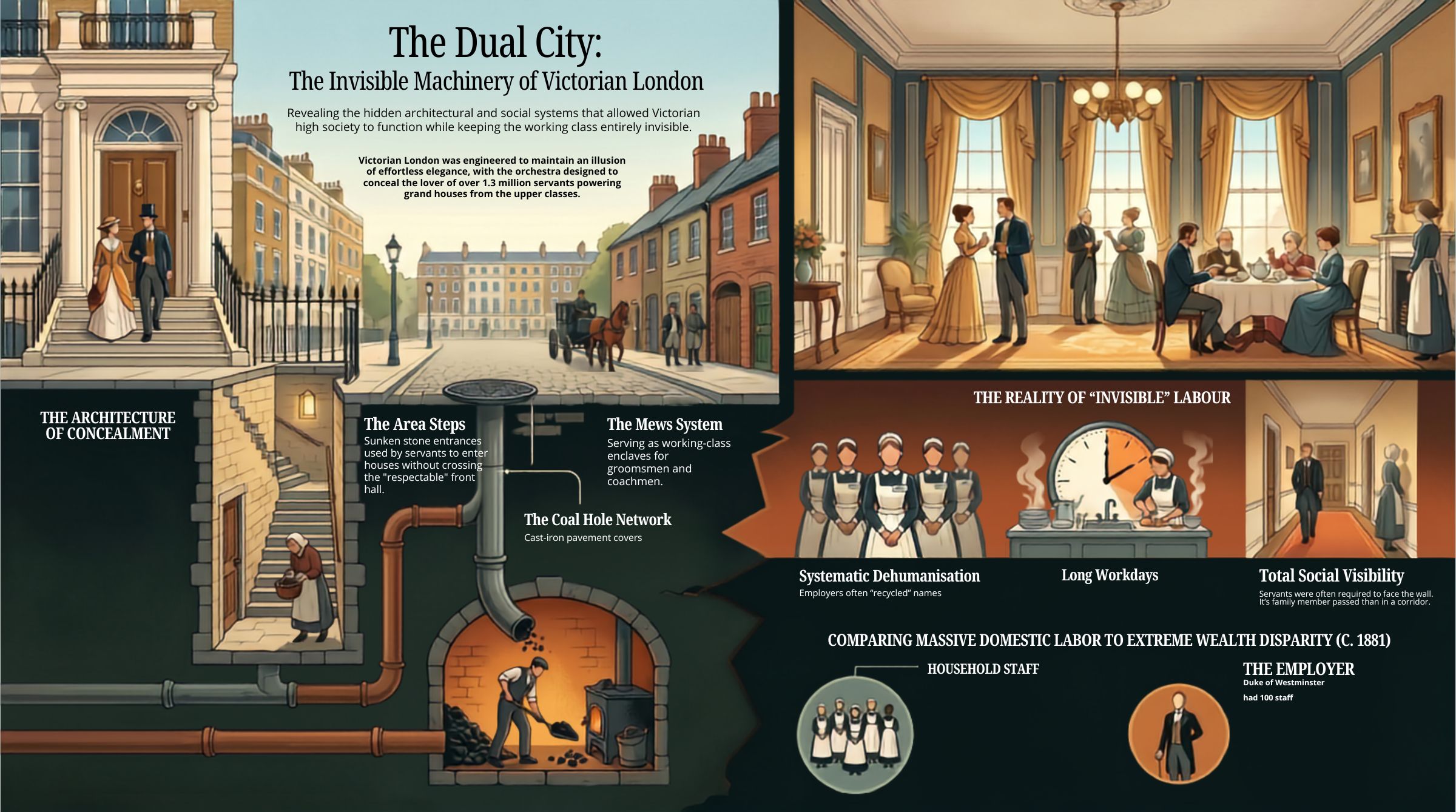
The Reality of “Invisible” Labour | Infographic
Explore London on Foot
Want to see these places in real life?
Join Hazel Baker and London Guided Walks for immersive walking tours across:
- Belgravia and Mayfair
- Kensington and Chelsea
- Victorian service streets and mews
🎟 Book public walks or private tours:
londonguidedwalks.co.uk
🎧 Related Podcast Episodes:
- Episode 107: Rats: A Victorian Problem
- Episode 115: Dr Jekyll and Mr Hyde
- Episode 134: Organ Grinders of Little Italy
- Episode 137: The Thames Tunnel
- Episode 143: Oliver Twist’s London
- Episode 157: From Factory Floor to Black Market: The Button Theft Scandal
🖇️Links to sources