Dive into the mysterious Button Theft Scandal of Victorian London, a tale of poverty-driven crime and shadowy networks. Learn how small, everyday items like buttons could fuel criminal ecosystems. Listen to the latest episode of the London History Podcast!


Host: Hazel Baker
Hazel is an active Londoner, a keen theatre-goer and qualified CIGA London tour guide.
She has won awards for tour guiding and is proud to be involved with some great organisations. She is a freeman of the Worshipful Company of Marketors and am an honorary member of The Leaders Council.
Channel 4: The Orient Express: A Golden Era of Travel (Episode 1). Channel 5’s Walking Wartime Britain(Episode 3) and Yesterday Channel’s The Architecture the Railways Built (Series 3, Episode 7). Het Rampjaar 1672, Afl. 2: Vijand Engeland and Arte.fr Invitation au Voyage, À Chelsea, une femme qui trompe énormément. Yesterday Channel / UKTV Play: The Architecture the Railways Built (Series 3, Episode 7). Yesterday Channel / UKTV Play: Secrets of the London Underground (Series 3, Episode 2) and Secrets of the London Underground (Series 4, Episode 10). NPO (Netherlands): Het Rampjaar 1672 – Afl. 2: Vijand Engeland. Arte France: Invitation au Voyage – À Chelsea, une femme qui trompe énormément
The Button Theft Scandal: Poverty, Receivers, and Crime at Worship Street Police Court (1870) Hazel Baker explores a late-December 1870 case at the crowded Worship Street Police Court in London’s East End, where three women—Elizabeth Brown (22), Charlotte Quigley (20), and her mother Charlotte Quigley (45)—were accused of stealing large quantities of commercially valuable buttons from Hackney manufacturer Mr. Williamson. Detective Chapman traced the missing buttons through a network of East End traders across Bethnal Green, Shoreditch, Hoxton, and Hackney, revealing systematic theft sustained by shopkeepers who bought “job lots,” kept poor records, and did not report suspicions, normalising receiving stolen goods. Brown confessed and said she was “driven to it by poverty,” and the episode situates the crime in severe East End economic distress and low-paid women’s work in the mechanised button trade. Magistrate Henry Jeffreys Bushby condemned the traders’ complicity and warned that failing to keep detailed purchase records could lead to prosecution; the case was remanded and the final outcome is unknown.
Timestamps:
00:00 Welcome to Worship Street
02:05 East End Scene Setting
04:22 Three Women in the Dock
05:06 Why Buttons Mattered
08:12 Detective Tracks the Network
10:17 Respectable Receivers Exposed
14:01 Bushby and Moral Outrage
15:31 Poverty Behind the Theft
19:29 How Stolen Goods Moved
23:27 Bushby Demands Paper Trails
25:13 What Happened Next
25:59 Why the Case Still Matters
28:38 Modern Streets and Final Thoughts
30:41 More Episodes and Farewell
From Factory Floor to Black Market: The Victorian Button Theft Scandal in London’s East End
Episode 157 – London History Podcast with Hazel Baker
Discover how a seemingly petty theft in Victorian London exposed a hidden black market running through the streets of Hackney, Bethnal Green, Spitalfields, Shoreditch and Hoxton.
In this episode of the London History Podcast, qualified London tour guide Hazel Baker takes you inside Worship Street Police Court in late December 1870, one of the busiest courts in the East End of London, to uncover the Button Theft Scandal – a case that reveals how poverty, factory work and “respectable” shopkeepers fuelled a thriving shadow economy.
Worship Street Police Court: Crime and Spectacle in Victorian East London
We begin in Worship Street Police Court, a cramped, overcrowded magistrates’ court on the edge of the City of London. Each morning its doors were besieged like the pit entrance of a cheap theatre: men in caps, women in shawls, errand boys and idlers jostling for a view of the dock.
The air is thick with coal smoke, damp wool and cheap tobacco; omnibus traffic and drays rumble past outside. This is not picture‑postcard London but a working machine – noisy, dirty and relentlessly public. Justice in Victorian London is fast, chaotic and on display.
In this setting, three East End women stand accused of something that sounds almost laughable: stealing buttons.
Why Steal Buttons? The Hidden Value of the Victorian Button Trade
In 1870s London, buttons were big business. Victorian clothing depended on them – coats, waistcoats, shirts, trousers, gloves and boots were all fastened with buttons, not zips.
Factories in Birmingham and London turned out thousands of metal, bone and mother‑of‑pearl buttons every day. Women and girls worked long hours at benches, punching, polishing and sorting. Others in crowded East End houses did piecework at home, carding buttons onto cards for shop display, paid by the thousand.
A gross (144 buttons) had real commercial value. Stolen in “several gross”, they became a compact, highly saleable commodity – easy to pocket on the factory floor, easy to tip into a tray in a small London shop, and almost impossible to trace.
From Hackney Factory Floor to East End Black Market
The case centres on Mr Williamson’s button factory in Hackney, where worker Elizabeth Brown once had a job. By the time Detective Chapman investigates, buttons have been disappearing in quantity.
His enquiries trace several gross of missing buttons through a network of traders across Hackney, Bethnal Green, Spitalfields, Shoreditch and Hoxton – a chain that reveals the shadow economy of the East End.
Elizabeth Brown, just 22, confesses quickly and says she was “driven to it by poverty”. She and Charlotte Quigley and her mother, also Charlotte, are not master criminals; they are women trying to survive in overcrowded lodging houses and tenements, living on insecure, low‑paid work.
Bethnal Green, Spitalfields, Shoreditch and Hoxton: Everyday Streets, Hidden Crime
The story moves through some of London’s most historic East End districts:
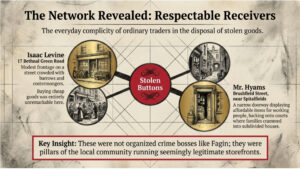
- Bethnal Green Road – a busy Victorian high street of barrows, fruit stalls and second‑hand clothes. Here, trader Isaac Levine admits buying buttons, but claims they arrived in cheap “job lots”.
- Brushfield Street, Spitalfields – a short street by Spitalfields Market, lined with small shops and backing onto densely populated courts. Shopkeeper Mr Hyams runs a perfectly ordinary business – on the surface.
These shopkeepers insist they bought mixed bundles of goods – bankrupt stock, damaged items, remnants – and kept only the vaguest of records. A smudged notebook, a few pencilled figures, loose coins: no invoices, no itemised ledgers, no questions asked.
This is how the East End black market functions: ordinary tradesmen using “job lots” to disguise stolen goods, blending them seamlessly into everyday commerce.
Magistrate Henry Bushby: Challenging Everyday Complicity
Presiding over the case is Magistrate Henry Jephson Bushby, newly arrived at Worship Street in 1870, educated at Eton and experienced in administration in Bengal.
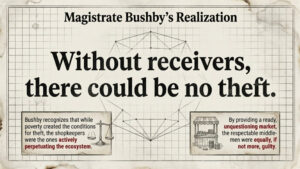
Bushby is not content to blame only the three women in the dock. From the bench in Worship Street Police Court, he does something unusual for Victorian London: he publicly challenges the “respectable” receivers – the shopkeepers and small traders.
He warns that:
- shopkeepers who fail to keep detailed records of their purchases
- and who do not ask questions about suspiciously cheap goods
can expect to stand in the dock as receivers of stolen goods.
In effect, he lowers the bar for proving intent. In his court, wilful ignorance is no longer a defence – it is evidence of complicity.
Poverty, Women’s Work and the Criminal Ecosystem in Victorian London
The Button Theft Scandal lays bare the link between poverty, women’s work and crime in 19th‑century London:
- The decline of silk weaving in Spitalfields and downturns in dockside industries left thousands in Bethnal Green, Hackney and Hoxton competing for scraps of work.
- Overcrowded houses shared standpipes and outside privies; families lived and worked in single rooms.
- Women like Elizabeth Brown and the Quigleys relied on poorly paid factory jobs and piecework, with no welfare state, no unemployment insurance and no safety net.
In this context, stealing small, valuable items from the factory – buttons, cloth, trimmings – could be seen as a desperate, rational, but dangerous way to survive.
At the same time, the case shows how ordinary London traders – not just fictional figures like Dickens’ Fagin – kept crime profitable by quietly absorbing stolen goods into the everyday economy.
Why This East End Button Theft Still Matters
So why does a 19th‑century button theft in Hackney and Bethnal Green matter today?
- It exposes how crime in Victorian London depended on both the desperate and the comfortable: thieves at the bottom, and receivers and shopkeepers in the middle.
- It highlights the precarious lives of working‑class women in the East End of London, living only days away from starvation if work was lost.
- It illustrates how industrialisation and anonymous supply chains made it easier for stolen goods to flow into legitimate markets – a pattern that feels strikingly modern.
When you walk through today’s Spitalfields, Shoreditch, Hoxton or Bethnal Green, with their busy roads, shops and flats above, you’re moving through streets shaped by exactly these histories of work, poverty and everyday complicity.
Listen to the Episode & Explore Victorian London
Listen to Episode 157 – “From Factory Floor to Black Market: The Button Theft Scandal” on the London History Podcast to hear the full story, complete with:
- atmospheric reconstruction of Worship Street Police Court
- the voices of Elizabeth Brown and the Quigleys in the records
- Detective Chapman’s investigation across East London
- and Magistrate Bushby’s remarkable attempt to hold receivers to account.
Walk Victorian London with Hazel
Want to stand in the very streets you’ve just heard about?
Join Hazel on a London history walking tour:
- Explore Victorian East London: Bethnal Green, Spitalfields, Shoreditch and Hoxton
- Discover real court cases, factory stories and street‑level social history
- Perfect for visitors, Londoners and anyone who loves London history
🎟 Book public walks or private tours:
londonguidedwalks.co.uk
🎧Related Podcasts Episodes:
Episode 104: Women’s Rights Activist Annie Besant
Episode 107: Rats – a Victorian Problem
Episode 134: The Organ Grinders of Little
Episode 147: The Prince, The Pauper and the Russian Flu