Join us as we explore the grim and fascinating history of executions at Smithfield, from the martyrdom of John Rogers and Anne Askew to the notorious hanging, drawing, and quartering of William Wallace. Discover how the market, St Bartholomew’s Hospital, and the surrounding streets formed the backdrop for these events, and learn how the atmosphere, public spectacle, and sensory experiences — the sights, the crowds, even the smell of the market — shaped contemporary reactions. Perfect for history enthusiasts, true crime fans, and anyone curious about the intersection of justice, faith, and public life in Tudor and medieval London.

Host: Hazel Baker
Hazel is an active Londoner, a keen theatre-goer and qualified CIGA London tour guide.
She has won awards for tour guiding and is proud to be involved with some great organisations. She is a freeman of the Worshipful Company of Marketors and am an honorary member of The Leaders Council.
Channel 4: The Orient Express: A Golden Era of Travel (Episode 1). Channel 5’s Walking Wartime Britain(Episode 3) and Yesterday Channel’s The Architecture the Railways Built (Series 3, Episode 7). Het Rampjaar 1672, Afl. 2: Vijand Engeland and Arte.fr Invitation au Voyage, À Chelsea, une femme qui trompe énormément. Yesterday Channel / UKTV Play: The Architecture the Railways Built (Series 3, Episode 7). Yesterday Channel / UKTV Play: Secrets of the London Underground (Series 3, Episode 2) and Secrets of the London Underground (Series 4, Episode 10). NPO (Netherlands): Het Rampjaar 1672 – Afl. 2: Vijand Engeland. Arte France: Invitation au Voyage – À Chelsea, une femme qui trompe énormément
 Guest: Maria Alexe
Maria Alexe is a performer and language specialist whose work explores the intersection between storytelling, place, and lived experience. With a background in the performing arts, she is particularly interested in how urban spaces function as stages for human drama, where history, memory, and narrative continue to unfold.
Smithfield: London’s Execution Ground and the Theatre of Punishment
Hazel Baker introduces Smithfield (West Smithfield by St Bartholomew’s Hospital, the meat market and St Bartholomew-the-Great) as a deceptively ordinary open space with a long history as both marketplace and London’s major stage for public execution. With tour guide Maria Alexe, the episode explains why Smithfield’s location outside the old walls helped authorities use it for spectacles of power and belief, from the first clearly recorded execution in 1305 (William Wallace, hanged, drawn and quartered) to the last clearly documented burning in 1612, alongside later uncertainty about continued hangings. It focuses on Tudor-era burnings for heresy, especially the Marian burnings (about 48 at Smithfield), and on Foxe’s Book of Martyrs, including John Rogers and Anne Askew. It also covers execution methods (hanging, burning, boiling alive) and the crowd’s festival-like atmosphere, then points to surviving traces in today’s Smithfield and the walking tours that explore them.
Timings:
00:00 Welcome to Smithfield
01:47 Where is Smithfield
03:03 Markets and Fairs
03:37 Why Executions Here
06:10 Timeline and Victims
08:13 Foxe and Martyr Memory
09:41 John Rogers Burning
11:11 Anne Askew Story
15:17 How Executions Worked
18:59 Boiling Alive Horror
24:02 Crowds and Spectacle
29:41 Did It Deter Crime
34:02 Traces in Smithfield Today
36:11 Tours and Farewell
🎧Related Podcasts Episodes:
Transcript:
Episode 156: Smithfield – London’s Theatre of Public Execution
Hazel 2026:
Welcome to the London History Podcast. I’m Hazel Baker from londonguidedwalks.co.uk, bringing you the people, places and events that have shaped the city we see today.
In this episode, we’re going to one of London’s most deceptively ordinary open spaces: Smithfield in the City of London. Today it’s a place of markets, lunch breaks and office shortcuts.
For centuries though, this smooth field on the edge of the Square Mile was one of London’s principal stages for public execution, where rebels, traitors and religious dissenters died in front of large crowds so that crown, state and church could send very public messages about power, loyalty and belief.
It was theatre – not the sort with velvet seats and an interval, but a carefully choreographed performance of pain, authority and, sometimes, martyrdom.
In this episode, I’ll walk you through what happened at Smithfield, why it mattered in London’s history, and what remains on the ground today. I’ll also be weaving in comments from City of London tour guide Maria Alexe, whose background in performing arts and languages means she thinks a lot about London’s streets as a kind of stage.
If you’d like more on the wider history of capital punishment in London, go back to Episode 92: “Public Executions”, where I talk to City of London tour guide Ian McDiarmid about how Londoners experienced executions across the city.
Where and What Is Smithfield?
First up: where and what is Smithfield? Let’s get our bearings.
When we say Smithfield in this episode, we’re talking about West Smithfield, not East Smithfield near the Tower of London. It’s the area around St Bartholomew’s Hospital and Smithfield Meat Market, with the church of St Bartholomew the Great tucked just to the north‑east. This is in the north‑west corner of the City of London, close to Farringdon.
This has been an open, relatively flat space for centuries. In crowded central London that’s always a clue: if it hasn’t been built over, something important has kept it clear. In Smithfield’s case that “something” was a long history as both marketplace and execution ground.
Hazel: Before I became a guide, walking through anywhere in London – whenever you see an open space, there’s a story there because otherwise it would be built on, wouldn’t it?
Maria Alexe: Yeah, absolutely. And Smithfield has this mix of modern and old, but it’s slightly more old than modern, I would say. You can definitely feel there’s something lurking about, that there’s some digging to be done there to discover some things. It’s got an air of mystery about it still.
Smithfield as Market, Fair and Execution Ground
Hazel 2026:
Smithfield has a longstanding role as a gathering place. Horse fairs, cattle markets, cloth and meat trading, and the great Bartholomew Fair all brought large crowds here well before, during and after its “theatre of execution” phase.
The fair itself is documented from the 12th century onwards and by the 17th century it’s notorious enough that playwright Ben Jonson sets an entire satirical comedy here, simply called Bartholomew Fair – all noise, booths, showmen and pickpockets swirling around the same ground we’re talking about.
Because it was outside the City walls but close enough to draw large crowds, Smithfield was ideal for public punishment. Authorities could gather people here for markets and fairs, and then use the same open space when they wanted a spectacle that would be seen, talked about and remembered across London.
Maria Alexe: Smithfield did offer quite a lot of geographical advantages as far as an execution spot was concerned – until it didn’t. As the city expanded, Tyburn became a better place for this kind of spectacle because it could accommodate more people, bigger crowds, whereas Smithfield had been, let’s say, engulfed by the city – by London essentially.
But while it was a popular place for executions during those few centuries, it is most famous for the burnings, particularly for what people call the Marian burnings or the burnings of heretics – Protestants – during the reign of Queen Mary I, Mary Tudor.
Heretics and traitors were the ones that usually found themselves at Smithfield facing their death.
Hazel 2026: Considering the location of Smithfield – because Tyburn’s quite a fair old way – it would have been a huge space and you could fit more people in there. But it does feel that Smithfield was used for executions of people whose deaths needed to be seen, and seen by particular audiences.
I suppose many of those influential names would have been living and working within the City at that time.
Maria Alexe: Absolutely. And it would’ve been very well situated for that kind of spectacle. It’s an easy walk from St Paul’s Cathedral, from Guildhall in the City of London, even from the Tower of London where some prisoners were held.
If they were marched from the Tower to Smithfield, that would have been maybe a 20–25 minute walk depending on the pace. They would have gathered enough crowds on the way, which would definitely have ensured the presence of as many citizens as possible.
Not to mention the fact that Smithfield, for perhaps longer than it had been used as a place for executions, had been used as a market and the site of the Bartholomew Fair, which attracted huge crowds.
Public Executions in Smithfield: Timeline and Types of Victims
Hazel 2026:
So when does Smithfield’s execution story begin, and who ends up dying here?
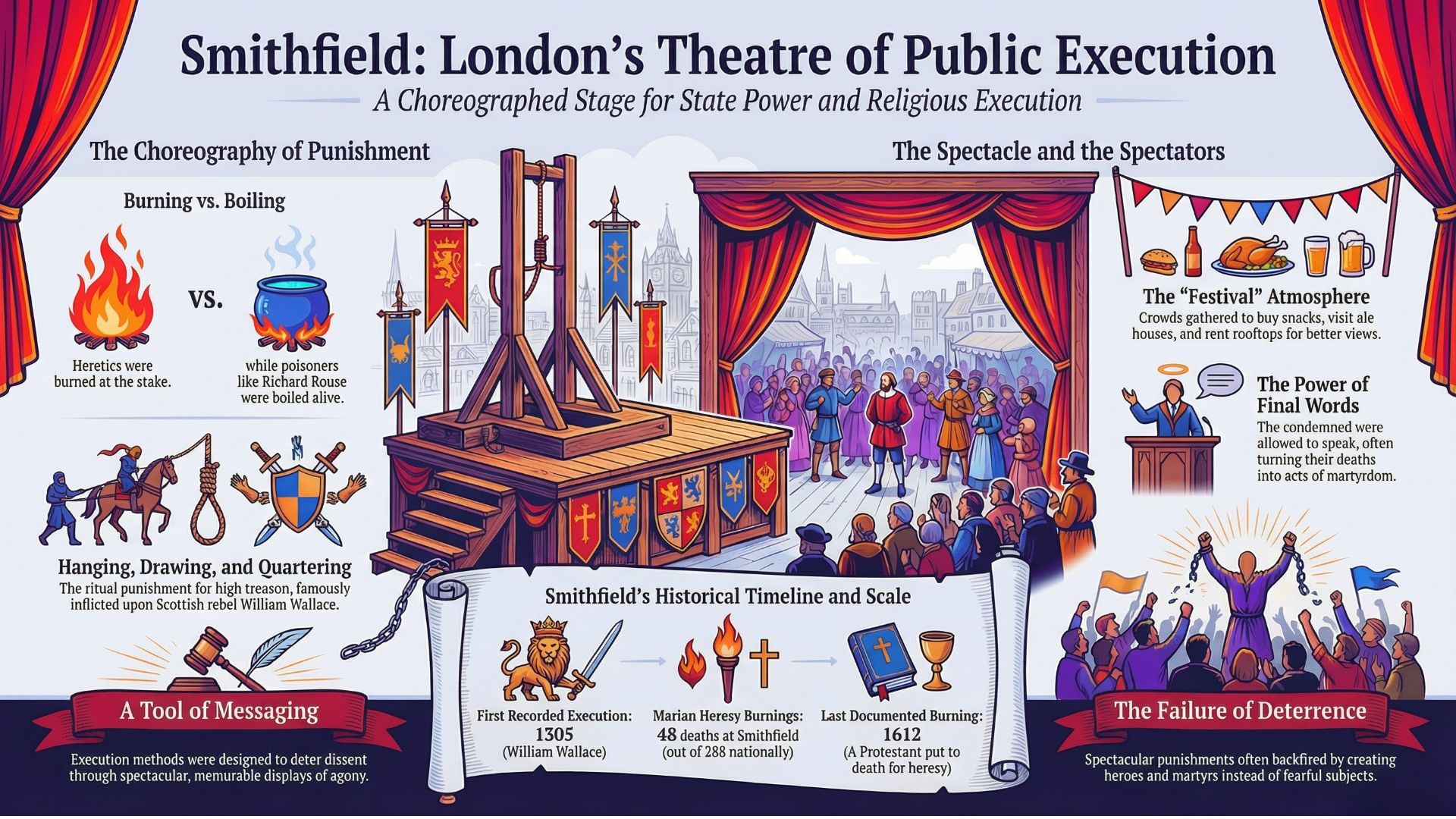
The first clearly recorded execution at Smithfield is in 1305, when the Scottish rebel William Wallace is hanged, drawn and quartered. Contemporary chronicles place his death at Smoothfield, the old name for Smithfield. The site may have been used for hangings earlier, but Wallace is one of the earliest securely attested cases.
The last clearly documented burning on record is in 1612, when a Protestant is put to death for heresy here. After that, official attention shifts more firmly towards places like Tyburn and, for elite beheadings, Tower Hill.
Some sources suggest hangings may have continued at Smithfield until the 18th century, but the evidence is patchy, so historians disagree.
By the Tudor period, Smithfield has a distinct role in London’s execution geography. Everyday thieves and pickpockets are more likely to find themselves at Tyburn, where hanging is the standard punishment for theft, smuggling, poaching, piracy and so on.
Smithfield, by contrast, becomes strongly associated with burnings for heresy and with high‑profile traitors and political or religious opponents. It sits alongside, rather than replaces, other sites on this wider London landscape of punishment.
Across Mary I’s reign, around 288 people are burned for heresy in England; about 48 of them die at Smithfield. Those numbers come from John Foxe’s huge martyrology. While modern scholars may quibble over one or two cases, the overall scale is clear: the fire here is part of a national campaign, but the choice of Smithfield – with its proximity to St Paul’s Cathedral, Guildhall, Newgate and the Tower of London – gives those deaths a particular political charge.
Foxe’s Book of Martyrs and Marian Burnings at Smithfield
One way we can get close to this world is through John Foxe’s Acts and Monuments*, usually known as Foxe’s Book of Martyrs. First published in 1563 and expanded in later editions, it devotes hundreds of pages to Marian burnings, including many at Smithfield.
Foxe gathers official records, eyewitness accounts, letters and woodcut illustrations to build long narratives of individuals burned for their beliefs. He has an agenda – he’s a convinced Protestant and wants martyrs to be remembered – but he also preserves voices we would otherwise have forgotten.
For generations, families read his stories at home, much like a grim alternative to the family Bible, so his version of events helped shape English memory of this period.
Maria Alexe: It’s really scary to think about, I have to say. Some of the accounts left to us by John Foxe, who wrote contemporary descriptions of the Marian burnings, are quite haunting.
One that stands out for me isn’t even the most horrific – it’s the vivid description of what the day looked like for the man in question. The man’s name is John Rogers. He was the first to be burned at the stake during the reign of Queen Mary; this was in 1555, and he was imprisoned in Newgate Prison, which is again a very convenient short walk from Smithfield.
Apparently in the morning it took a lot of shaking to wake him up. That detail haunts me, because you can imagine: you’ve been trying to sleep all night, it’s been difficult, then you finally fall asleep in those sweet hours of the morning – and someone shakes you awake saying, “It’s time to be burnt alive.”
Hazel 2026: The imprisoned John Rogers at Newgate asks to see his wife one last time – and is refused. A small, brutal decision that tells us a lot about how tightly controlled this performance is meant to be.
Foxe has him going to the stake, praying for his accusers and refusing to recant, even lifting his hands towards heaven as far as his chains will allow. We have to allow for Foxe’s bias in the way he tells it, but we can see why scenes like this helped to turn executed heretics into enduring martyrs of Smithfield.
Anne Askew: A Smithfield Martyr
Another figure whose story has resonated for centuries is Anne Askew – a young woman from Lincolnshire who reads the Bible for herself, shares it aloud and refuses to give the answers her interrogators want. Uniquely, some of her own examinations were written up and circulated, so we hear her voice more directly than we do for most people in her position.
Maria Alexe: We can’t really mention Smithfield and not mention Anne Askew. She was a Protestant martyr, and she fell foul of King Henry VIII, who was feeling threatened by people who read the Bible for themselves and interpreted it in their own way – exactly what Anne did.
She was married pretty much against her will, but as a dutiful daughter she went ahead with it at age 15 to a man who was a fervent Catholic. She found comfort in reading the Bible, and she found her calling in reading it out loud to anyone who would listen, including publicly – something women were not allowed to do at the time.
It wasn’t long before she got in trouble with the authorities, not least because by now she was seeking a divorce from her husband. Add that to her independence and you can see why she attracted attention.
She was rumoured to be close to people who knew Queen Katherine Parr, Henry VIII’s last wife, who was also a Protestant. For all these reasons, Anne fell under suspicion, was interrogated and tortured on the rack in the Tower of London because she refused to name others. She didn’t want to get other people in trouble – and she never did.
As a result, she ended up being carried to her execution at Smithfield. She had to be brought in a chair on a cart because she was unable to walk or stand. That’s the condition in which she went to her death. A contemporary description says she went with a kind of smile on her face – we can’t be sure, but she seems to have made her peace with what was happening.
If you read her own accounts of the examinations, she didn’t necessarily seek martyrdom. She uses careful, clever answers to avoid trapping herself or others. She comes across as very intelligent – but there was only so long she could withstand the assault on her beliefs and her body. She became a Smithfield martyr.
Hazel: I think the easiest way of describing Anne Askew is that they could break her body but not her spirit.
Maria Alexe: Yes, it sounds like it was exactly like that until the very end. Anne doesn’t seem to have sought martyrdom. Her recorded examinations show a clever, cautious woman trying not to incriminate others, but the combination of torture, public burning and then publication in Foxe’s book makes her one of Smithfield’s defining Protestant martyrs.
Methods of Execution at Smithfield: Hanging, Burning, Drawing and Quartering
Hazel 2026:
Executions at Smithfield use several different methods, each carrying its own message.
The most familiar is hanging. The convicted person stands on a ladder or in a cart, a noose is put around the neck and the support is removed. If the drop is long and the angle right, the neck breaks; more often in the medieval and early Tudor period they slowly suffocate. The more modern “long drop” designed to break the neck cleanly belongs to a later reforming age.
For heresy, the standard punishment is burning at the stake. The condemned is tied to a post on a pile of faggots – bundles of wood and kindling. How long they suffer depends on wind, fuel and smoke.
In some cases, smoke inhalation kills relatively quickly; in others, damp wood or awkward wind keeps them alive longer. Accounts from the period talk about fires “ill kindled” or “ill ordered” taking far longer than anyone wished.
Maria Alexe: There are accounts of two Protestants during the Marian burnings who were friends and executed together, tied back to back at the stake. One of them died long before the other because of the way the wind was blowing; the other had to suffer alive, being burned while his companion was already dead.
How quickly someone died also depended very much on the amount of smoke they inhaled. If they were really “lucky”, they would die from smoke inhalation fairly quickly. We must keep in mind that the fire burned beneath them, on a stack of faggots – bundles of dry wood and kindling.
People watching reacted with shock, grief, sometimes with grim delight if they thought the person deserved it – and perhaps with fear if they felt any kinship in belief or background.
Hazel 2026: Modern medical understanding suggests that once the outer layers of skin and their nerve endings are destroyed, the capacity to feel pain in that area is lost. It’s a very small theoretical comfort, because the minutes before that point would have been hideous.
For high treason, men faced the full ritual of being hanged, drawn and quartered.
Maria Alexe: According to some sources, Smithfield had been in use as a hanging place for a while by the time one of the most notorious executions happened there in 1305 – William Wallace, the Scottish “freedom fighter”.
Hazel 2026: William Wallace’s death at Smithfield is the classic example. That grisly sequence isn’t unique to Wallace; it’s the formal penalty for high treason in English law right into the 19th century, although in later centuries much of it is carried out after death or commuted altogether.
The distribution of heads and quarters to different towns is meant to turn a single execution into a kingdom‑wide warning.
Boiled Alive at Smithfield: Richard Roose and Tudor “Justice”
As if that weren’t enough, Smithfield also witnesses one of the most shocking punishments in Tudor England: boiling alive.
Maria Alexe: When we make jokes about how violent “medieval times” were, we sometimes say, “Oh, you’d get boiled to death just for saying something.” It wasn’t quite like that – but I’m afraid boiling people alive was a real method of execution.
And it wasn’t even that long ago. There’s a record of a man called Richard Roose (or Rouse) who was boiled alive at Smithfield in 1531. To me that’s particularly shocking because 1531 is not the “Dark Ages”; it’s the Renaissance. Art has been flourishing in Europe for centuries, science is poking its head up, people are navigating the globe – and yet in the reign of Henry VIII, a man is boiled alive in Smithfield.
This punishment was usually reserved for poisoners, though some sources say it could also apply to coin‑forgers. Poisoning was considered a particularly cowardly, heinous form of murder.
Roose was a cook working for the Bishop of Rochester. He prepared a meal after which many in the household – though not the bishop, who didn’t eat it – became ill and two people died. We don’t know whether he intended to poison anyone; he denied it, and it may have been a tragic case of severe food poisoning.
What we do know is that the “appropriate” punishment was judged to be boiling alive. He was placed in a kind of cage or gibbet and immersed repeatedly in a cauldron – in his case of boiling water – until he died. Accounts suggest this lasted a couple of hours. Reports say people were quite literally sickened; some fainted and were horrified by what they saw.
Hazel: And also, watching someone suffer for two hours – who’s got the stomach for that? It’s not even dramatically “effective”; he’s dunked into the boiling cauldron and hauled out again, cooling slightly between immersions. It just sounds absolutely horrendous.
Hazel 2026: Boiling is introduced by statute under Henry VIII, specifically for poisoners. Roose’s execution at Smithfield becomes notorious. Another known case involves a woman, Margaret Davy, boiled after poisoning her employer’s household.
By 1547, after Henry VIII’s death, the law permitting boiling is repealed – a small sign that even in the 16th century there are limits to what contemporaries consider acceptable.
There may also have been at least one trial by combat here – a legal duel to settle an accusation of treason – though the evidence is messy. The one detailed example ends not with a clean kill but with a fighter collapsing from exhaustion. Trial by combat is recognised in medieval law but, in practice, is rare and fading out by the 15th century.
What Was It Like to Attend an Execution at Smithfield?
What would you experience if you turned up at Smithfield on an execution day? Authorities stage the whole thing as a procession and performance.
Maria Alexe: I don’t want to be disrespectful – this is people being killed – but for some, it would have felt almost like a sports event or a fair. Public executions didn’t happen every day, but wherever there are crowds, that atmosphere creates itself.
You’d have pickpockets, anyone selling food or goods, seizing the opportunity. Pubs would be open; people might go in for pints before or after. Those with particularly morbid curiosity, or who were pleased to see the condemned die, might pay a premium to watch from windows, balconies or rooftops – good vantage points over the execution ground. There was money to be made.
The convicted person would be taken to their place of execution. Depending on the distance, this could take a while; they might walk, or ride in a cart. That procession itself was another chance to draw crowds.
On the way, depending on the politics of the moment and the popularity – or unpopularity – of the person, they might be booed and pelted, or cheered and greeted like a hero.
At the execution spot they were usually allowed to speak – to share final thoughts, to recant, to ask forgiveness from God, to confess additional crimes, or to proclaim their innocence and attack their accusers. Some managed to work the crowd and gain sympathy; others achieved the opposite.
Hazel 2026: At Smithfield, the open space is ringed with people: those on the ground, street sellers and pickpockets working the crowd; alehouses open; upper windows rented out as premium seating.
Diaries and court records from London and other cities describe people paying for a window or climbing onto roofs for the best view of the scaffold or stake.
Printers often publish these “last dying speeches” as cheap pamphlets, so we know a surprising amount about what was said. In the case of religious martyrs, those final words could be as important as the manner of death.
Reactions range from horror and grief, to real satisfaction that an enemy is being punished. Crucially, the authorities run a risk: in trying to terrify spectators into obedience, they sometimes create heroes – especially when powerful beliefs and powerful stories meet a sympathetic audience.
These punishments are engineered to do more than kill. They’re meant to deter treason and heresy by putting fear into everyone watching, and by creating examples that live on in memory.
We can see all the work people do to avoid them: church sanctuary, benefit of clergy, pregnancy pleas, escape, flight abroad. Legal records are full of people trying every possible route to avoid the gallows or the stake.
Over the very long term, England abolishes the death penalty in the 20th century, and reconstructed murder rates are far lower today than in the Middle Ages. Judged by statistics and by the persistence of dissent, spectacular punishment looks less like an effective deterrent and more like a brutal tool of messaging that often backfires.
Did Public Executions in London “Work”?
Hazel 2026: We’ve talked a lot about the suffering and the political and religious motives on either side, but ultimately these punishments were designed to put fear into everybody watching. From your reading, do you think public executions – especially at Smithfield – actually worked?
Maria Alexe: In a nutshell, my personal opinion is no. I don’t think punishments had the effect the authorities hoped for – especially when you’re dealing with people who genuinely believe they’re on God’s side and headed for an afterlife where everything will be all right.
If you think recanting your beliefs will condemn your soul to eternal damnation, you’re not going to recant.
I’m sure executions deterred some people from speaking publicly about their beliefs – I know I would have thought carefully before saying anything! But if we broaden it out to crime in general, and look at crime statistics, it doesn’t look as though these punishments worked as a deterrent. Murder continued; crime continued.
One of the murder capitals of Britain in medieval times was actually Oxford, probably because of the concentration of young men and alcohol – the murder rate there was many times higher than in cities like London or York. That tells me that even educated people, who knew the law and penalties, still went ahead and did it.
Hazel: If you think of authorities using these as demonstrations of power, you could say that worked, perhaps. But they also ran the risk of undermining their own message by creating heroes and martyrs.
Maria Alexe: Exactly. And there were always ways people hoped to escape punishment: running away, killing witnesses, pleading pregnancy, claiming sanctuary for 40 days and then fleeing abroad, or simply escaping from prison – security wasn’t what it is today.
So, no – nowhere near the extent the authorities hoped. And if you look at the fact that the death penalty has been abolished in Britain and the murder rate has dropped significantly since medieval and Tudor times, that’s another indicator that public executions weren’t the deterrent people imagined.
Traces of Smithfield’s Execution History on the Ground Today
Hazel 2026:
So if you stand in Smithfield now – perhaps at the end of our “Bleeding Hearts and Body Parts” walking tour, or our “Heretics and Horrors” walking tour – what traces of this story can you still find?
You have Smithfield Market, a site of meat trading for almost a thousand years, even though the current market buildings are 19th‑century.
You have St Bartholomew’s Hospital, founded in the 12th century and still operating on the same site.
You can still walk through the Gothic gateway that once marked the entrance to the priory church of St Bartholomew. Later, a timber‑framed Tudor house was planted right on top of it – a wonderfully blunt visual statement of the new regime sitting on top of the old.
Step through that gateway and you reach St Bartholomew the Great, one of the oldest surviving churches in London, with substantial Norman stonework that would have been familiar to many who witnessed the executions.
Street names whisper the older stories too. Cloth Fair remembers the cloth market that formed part of Bartholomew Fair. Merchants lodged and traded here during fair time, and some of those medieval property lines still shape the streets today.
A short walk away at Pye Corner, a small gilded boy marks the supposed spot where the Great Fire of London finally burned out – another little figure on a wall, loaded with moralising stories about sin and punishment.
When I bring groups today, what strikes many of them is the contrast. We pause for a coffee, nip into the hospital for a scan or a blood test, just yards from where crowds once watched neighbours and strangers put to death.
Today, Smithfield is a place to cut through on your lunch break, have a drink, visit a hospital or join a guided walk – rather than watch an execution. But if you know where to look and what to imagine, it remains one of London’s most revealing places to think about justice, memory, belief and the stories a city chooses to tell about itself.
Walk Smithfield: London Execution Tours with London Guided Walks
If you’d like to explore more of this history on the ground, then join me, Maria or one of our colleagues on our Bleeding Hearts and Body Parts walking tour, which finishes in the Smithfield area in the City of London.
It’s also available as a private tour for groups. You’ll find all the details at londonguidedwalks.co.uk, along with show notes and links to some of the sources mentioned in this episode.
Thanks for listening to the London History Podcast. I’m Hazel Baker. Until next time!
🔊Related Podcasts: