Join us as we explore Amelia Earhart’s visits to London in the 1920s and 1930s, from her social work inspirations at Toynbee Hall to the glamour of Selfridges, where her plane went on display. Discover how tea with the Prime Minister, appearances at Wimbledon and Ascot, and encounters with figures like Winston Churchill and Lady Astor shaped her public image and revealed the scale of her fame. Perfect for history enthusiasts, aviation fans, and anyone curious about the making of a modern icon.

Host: Hazel Baker
Hazel is an active Londoner, a keen theatre-goer and qualified CIGA London tour guide.
She has won awards for tour guiding and is proud to be involved with some great organisations. She is a freeman of the Worshipful Company of Marketors and am an honorary member of The Leaders Council.
Channel 4: The Orient Express: A Golden Era of Travel (Episode 1). Channel 5’s Walking Wartime Britain(Episode 3) and Yesterday Channel’s The Architecture the Railways Built (Series 3, Episode 7). Het Rampjaar 1672, Afl. 2: Vijand Engeland and Arte.fr Invitation au Voyage, À Chelsea, une femme qui trompe énormément. Yesterday Channel / UKTV Play: The Architecture the Railways Built (Series 3, Episode 7). Yesterday Channel / UKTV Play: Secrets of the London Underground (Series 3, Episode 2) and Secrets of the London Underground (Series 4, Episode 10). NPO (Netherlands): Het Rampjaar 1672 – Afl. 2: Vijand Engeland. Arte France: Invitation au Voyage – À Chelsea, une femme qui trompe énormément
 Guest: Rachel Hartigan
Rachel Hartigan is a journalist and author of Lost: Amelia Earhart’s Three Mysterious Deaths and One Extraordinary Life. Her work explores both Earhart’s remarkable aviation career and the enduring mysteries surrounding her final flight.
Rachel’s research focuses on Earhart’s visits to London after her record-breaking transatlantic flights in 1928 and 1932, examining how the city both shaped and reflected her rising fame. She delves into Earhart’s interactions with prominent figures, London society, and the media, bringing to life the experiences that transformed her into a global icon.
When not researching or writing, Rachel enjoys uncovering stories of historical figures, blending cultural insight with narrative to illuminate the past for modern audiences.
Hazel Baker: Hi, I’m Hazel Baker, podcast host and London tour guide at londonguidedwalks.co.uk, and you’re listening to the London History Podcast.
Today, I’m joined by journalist and author Rachel Hartigan. Her new book, Lost: Amelia Earhart’s Three Mysterious Deaths and One Extraordinary Life, dives into both Amelia Earhart’s incredible career and the enduring mysteries surrounding her final flight.

The Cover of Lost Book | Rachel Hartigan
Host Hazel Baker interviews journalist and author Rachel Hardigan about her book “Lost Amelia Earhart’s: Three mysterious deaths and one extraordinary life,” focusing on Earhart’s London connections and how the city revealed the scale of her sudden fame. They discuss Earhart’s 1928 transatlantic crossing on the Friendship (as a passenger) that landed in Wales before continuing to Southampton, and how London’s elite embraced her with events like Ascot, Wimbledon, and appearances alongside figures including Winston Churchill and Lady Astor. The episode highlights Earhart’s visit to Toynbee Hall, reflecting her settlement-house social work roots, and her 1932 return after a solo Atlantic flight, including Selfridges displaying her plane and providing her clothes. They compare British and American press portrayals, explore sources used in research, and consider Earhart’s legacy on gender, celebrity, and aviation optimism.
00:00 Amelia Meets London
01:48 Rachel’s Earhart Journey
03:31 The 1928 Atlantic Crossing
07:58 London Welcomes a Star
10:52 Toynbee Hall Roots
13:54 Selfridges and Style
15:36 Mixing With Power
17:39 Fame and the Press
21:21 Researching the Record
26:07 Legacy and London Today
29:07 Wrap Up and Where to Find
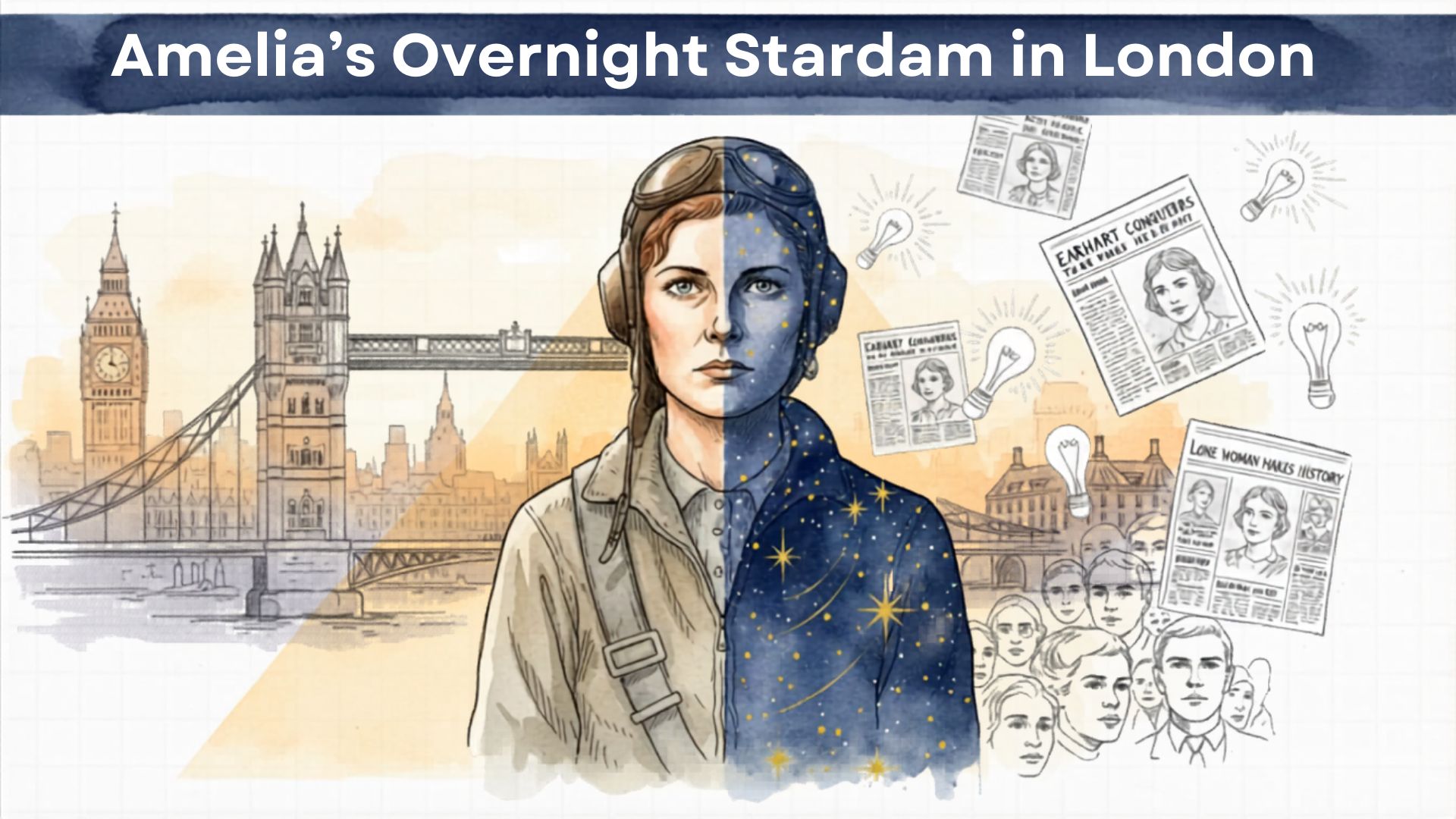
Episode 155 – Tea with Churchill: Amelia Earhart’s London Story
Discover Amelia Earhart’s surprising relationship with London, from settlement houses in the East End to the glamour of Selfridges, Wimbledon and Ascot.
In this episode of the London History Podcast, London tour guide and podcast host Hazel Baker talks with journalist and author Rachel Hartigan, whose new book Lost: Amelia Earhart’s Three Mysterious Deaths and One Extraordinary Life explores both Earhart’s remarkable aviation career and the mysteries surrounding her final flight.
We focus on Amelia Earhart’s time in London in the late 1920s and early 1930s – the visits that helped transform a relatively unknown Boston social worker into a global celebrity aviator.
Amelia Earhart and London: Why This Story Matters
Amelia Earhart is one of the best‑known names in aviation history, but her connections with London and the UK are much less familiar.
In this London‑centred episode, we explore:
- How Earhart’s work at Toynbee Hall in London’s East End inspired her social work in Boston.
- How Selfridges on Oxford Street put her plane on display and dressed her after she crossed the Atlantic with no spare clothes.
- How tea with the Prime Minister, appearances at Wimbledon and Royal Ascot, and sharing platforms with Winston Churchill and Lady Astor turned her London stays into a trial by fire in the crucible of fame.
- What Earhart’s London days reveal about celebrity, gender, aviation and the making of a modern icon between the wars.
About Our Guest: Rachel Hartigan
Rachel Hartigan is a journalist and author whose work has appeared in National Geographic and other major outlets. She is the author of:
Lost: Amelia Earhart’s Three Mysterious Deaths and One Extraordinary Life
Her book investigates three leading theories of Earhart’s disappearance while also telling the story of her extraordinary life, including her visits to London after record‑breaking transatlantic flights in 1928 and 1932.
Rachel first became involved with Earhart’s story almost by accident: an editor at National Geographic offered her a berth on a ship heading to a remote Pacific island where some believe Earhart may have died. That assignment led to a deep dive into Earhart’s life, legacy and the many investigations into her final flight.
Setting the Scene: London in 1928 and 1932
When Amelia Earhart first arrived in Britain in 1928, she had just crossed the Atlantic Ocean as a passenger on the Fokker F.VII aircraft Friendship.
A Transatlantic Flight Aimed at London
- In 1928, Earhart was working as a social worker in Boston and flying only occasionally due to the high cost of aviation.
- After Charles Lindbergh’s solo Atlantic flight in 1927, there was a race to make a woman the first to cross the Atlantic by air.p
- Amy Phipps Guest, an American heiress living between the US and Britain, wanted an American woman – “the right sort of girl” – to make the flight.
- When her family forbade her from flying herself, she sponsored another woman instead, and her lawyer eventually found Amelia Earhart in Boston.
Earhart joined the flight as a passenger rather than the pilot, but that did not dampen the public excitement. The aircraft was aiming for London, but navigation challenges and limited technology meant they ultimately landed at Burry Port in Wales, before continuing on to Southampton.
A City Primed for Aviation Heroes
By the late 1920s, London and Britain were already excited by aviation:
- British aviators like Lady Mary Heath had completed long‑distance flights, including routes from South Africa to London.
- Newspapers and the public were fascinated by daring flights and record‑breaking journeys.
- London’s elite and political circles were eager to be associated with cutting‑edge technology and bold new figures.
When Earhart stepped out of the plane in Southampton, the crowd and press focused almost entirely on her – largely ignoring the pilot and co‑pilot, despite their skill and the pilot’s struggle with a serious hangover during the flight. From that moment, Earhart’s relationship with London began.
Toynbee Hall, the East End and Social Work Roots
One of the most important London locations in Earhart’s story is Toynbee Hall in the East End.
Toynbee Hall as a Model for Boston
- Earhart had been working at Denison House, a settlement house in Boston inspired by Toynbee Hall.
- The settlement movement encouraged young, educated, “well‑meaning” people to live in poorer neighbourhoods, providing services and acting as role models.
- In Boston, Earhart worked with immigrant communities, including Chinese and Syrian families, organising girls’ basketball, plays, medical visits and more.
When she visited Toynbee Hall in London, she expected to return to Boston and continue social work, believing the transatlantic flight was a temporary adventure rather than a life‑changing event.
Earhart Taking Notes in the East End
At Toynbee Hall:
- Earhart was so inspired that she grabbed an envelope and took notes on programmes and ideas she wanted to adapt for Boston – such as music groups and baby day‑care.
- She also noticed the financial struggles of such institutions, noting how hard it was to fund these forward‑looking social services.
This visit shows Earhart not only as an adventurer and pilot, but as someone deeply engaged with social reform, community work and practical optimism, bridging Boston and East London.

Selfridges, Oxford Street and the Glamour of London Retail
On Earhart’s second major visit to London in 1932, after her solo transatlantic flight, Oxford Street’s famous department store Selfridges played a starring role.
A Plane on Display at Selfridges
- In 1932, Earhart flew solo across the Atlantic and landed in Ireland when she had originally intended to reach Paris.
- She arrived in Britain with almost no clothing, having carefully weighed every ounce on the flight to accommodate fuel.
- At Selfridges in London, her aircraft was placed on display on the first floor, drawing huge crowds and linking modern aviation directly with modern retail culture.
Clothes in Exchange for Publicity
Selfridges’ founder Harry Gordon Selfridge, a master of publicity, arranged a deal: display the plane and in return Earhart would receive a new wardrobe from the store.
- Earhart was initially hesitant to accept free clothes but was persuaded that she genuinely needed them.
- She had a keen sense of style and became known as a strikingly elegant dresser, which enhanced her public image.
- Her husband and publisher George Putnam, already adept at publicity thanks to Charles Lindbergh’s book, likely encouraged this arrangement as a way to build her global profile.
Selfridges thus became a key London site where aviation, fashion, celebrity and commerce intersected in Earhart’s story.
Wimbledon, Ascot and Tea with the Prime Minister
During her London visits, Earhart was rapidly absorbed into high society and political life.
She was invited to:
- Wimbledon – witnessing top‑flight tennis in SW19.
- Royal Ascot – joining one of Britain’s most prestigious race meetings, rich with royal and aristocratic connections.
- Tea with the Prime Minister – a sign of how quickly she had become a matter of national and international interest.
London’s elite cleared their schedules to welcome her, taking her to the highlights of England and showcasing her as a symbol of modernity, courage and the future of flight.
Winston Churchill, Lady Astor and the London Political Elite
Earhart’s London visits brought her into contact with some of the most influential figures of the day.
Winston Churchill and the Women’s Aviation Committee
- Earhart spoke at a women’s committee for aviation alongside Winston Churchill, who at that time was well‑connected with Amy Phipps Guest and her circle.
- This placed Earhart at the heart of discussions about the future of aviation in Britain, not just as a guest of honour but as an articulate advocate.
Lady Astor and Anglo‑American Connections
Earhart also mixed with Lady Nancy Astor, the first woman to take a seat in the House of Commons and another American‑born figure who became central to British politics.
Her presence alongside figures like Churchill and Astor underscored:
- Her role as a bridge between American and British societies.
- The willingness of London’s political elite to associate themselves with female pioneers in aviation.
Raised in a prominent family in Kansas, Earhart had later attended a finishing school near Philadelphia, giving her the social polish to move comfortably in such circles, even if she had never expected to do so. Rather than being intimidated, she appears to have met these encounters with curiosity and composure.
Media, Celebrity and the “Crucible of Fame” in London
Rachel describes Earhart’s London trips as a “trial by fire in the crucible of fame”.
From Boston Social Worker to Global Icon
When Earhart first arrived in Britain in 1928:
- She had previously only appeared in American newspapers as a local or niche aviation figure.
- In London, she was suddenly front‑page news, day after day, across the British and international press.
She quickly realised:
- How intensely the press could focus on her appearance, including comments on an ill‑fitting borrowed brown dress as she arrived.
- How journalists sometimes invented dialogue, presenting her as a stereotypical “ignorant Yankee” in conversation with the Prince of Wales, language she insisted she never used.
Creating the “Aw‑Shucks” Public Persona
Over time, Earhart:
- Developed a public persona that was modest, self‑effacing and slightly aw‑shucks in tone – talking about flying “for fun” and downplaying her ambition.
- Privately worked very deliberately, with George Putnam, to manage her image, secure sponsorships and keep aviation in the public eye.
The British press could be more snarky and ironic than the early American coverage, particularly about her clothes and manner, while US outlets tended initially toward hero worship. By the time of her later flights, including Hawaii–California, both British and American journalists began to ask:
- Was there still a scientific or practical purpose to these flights?
- Or were they largely about fame, records and publicity, especially given the number of pilots who had died chasing similar goals?
London’s media therefore played a crucial role in shaping and questioning Earhart’s global image, helping to turn her into both an icon and a subject of scrutiny.
Letters, Diaries and the Paper Trail: Researching Earhart in London
To piece together Earhart’s London story, Rachel draws on a wide range of sources:
- Earhart’s own writing – including a book written soon after her Atlantic crossing, and dispatches she wrote daily for the New York Times whilst in Britain.
- Contemporary newspapers – British and American coverage which document her visits to Toynbee Hall, Wimbledon, Ascot, Selfridges and political events.podscan+1
- Archival collections – notably the Earhart papers held at Harvard University and Purdue University.researchhub+1
- Letters to her family, especially her mother, which reveal shifts in tone as she goes from struggling professional to financial provider and sometimes controlling adviser.
One striking detail is that Earhart’s family did not know she was taking part in the 1928 flight; she left letters and a will to be opened if she did not return. Later, as she became more famous and financially successful, she took a more directive role in how her family lived and spent money, reflecting the complexities of sudden celebrity and responsibility.
London, Women’s Rights and a Changing World
Earhart’s London story is deeply entwined with changing roles for women in Britain and beyond.
- 1928 – the year of her first Atlantic crossing – was also the year when British women first won the right to vote on equal terms with men, after the Representation of the People (Equal Franchise) Act.
- Fashion and culture reflected this change: shorter skirts, bobbed hair and more public, independent lives for women.
Earhart became a powerful symbol of:
- A woman taking part in technologies previously seen as a male preserve.podscan+1
- The belief that women should be free to do whatever men did, not limited to domestic roles.
London, ready to celebrate this modern femininity, welcomed her as living proof that women could cross oceans, shape public life and embody the future of flight.
How Should We Remember Amelia Earhart’s London Connection?
Rachel argues that Amelia Earhart still resonates today because she refused to be confined by traditional female roles and because she embodied a forward‑looking, optimistic vision of what technology and courage could achieve.
London played a key role in that story:
- It was the city that greeted her after both of her most famous transatlantic feats, in 1928 and 1932.
- It offered platforms – from Toynbee Hall to Selfridges, Wimbledon, Ascot and Westminster – that helped to broadcast her image to the world.
- It became a stage on which aviation, gender politics and mass media collided, forging the modern concept of celebrity.
If Amelia Earhart Visited London Today…
Rachel imagines that if Earhart were dropped into modern London, she would adapt instantly.
- She might head straight for the London Eye, echoing the thrill she felt on a Ferris wheel at the 1904 St Louis World’s Fair, her first taste of height.
- She would likely explore the Tate and London’s cultural institutions, fascinated by modern art and the city’s diversity.
- She would probably be more curious than shocked by smartphones, fast traffic and multicultural crowds, eager to understand each new development.
Rachel suggests that Earhart’s curiosity and modern outlook were so strong that she might not seem out of place in 21st‑century London at all.
Where to Find Rachel Hartigan’s Book
You can find Lost: Amelia Earhart’s Three Mysterious Deaths and One Extraordinary Life:
- Through major booksellers online and in‑store, including Amazon.
- Via links on Rachel’s official website: rachelhartiganauthor.com (as given in the episode).
There you’ll also find:
- More about her research into Earhart.
- Links to her social media channels.
- Information about other projects.
Listen to “Tea with Churchill: Amelia Earhart’s London Story”
This episode is part of the London History Podcast, produced by London Guided Walks.
- Episode title: 155: Tea with Churchill – Amelia Earhart’s London Story
- Host: Hazel Baker, London tour guide and podcast host
- Guest: Rachel Hartigan, journalist and author
If you enjoyed this London‑focused deep dive into Amelia Earhart’s life:
- Follow the London History Podcast.
- Leave a review on your favourite podcast app.
- Share the episode with someone who loves London history, aviation or extraordinary women.