Introduction
The Festival of Britain is usually associated with London’s South Bank, but few people realise that one of its most ambitious projects was located in Poplar, East London. As the Festival celebrates its 75th anniversary, it is worth exploring the remarkable story of the Lansbury Estate, a pioneering post-war housing development that embodied Britain’s optimism for the future.
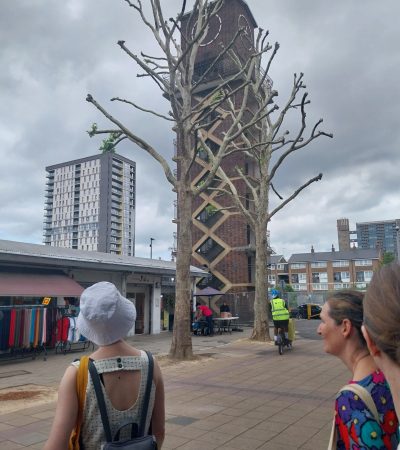
Situated near Crisp Street Market, close to East India Dock Road and today’s Canary Wharf, the Lansbury Estate was designed as a living exhibition of modern town planning. It demonstrated how communities could be rebuilt after the devastation of the Second World War, creating neighbourhoods centred on green spaces, schools, shops and local amenities.
The Festival of Britain Beyond the South Bank
Although millions visited the Festival’s famous South Bank site, the Festival also extended to several locations across London.
One of the most significant was the Lansbury Estate in Poplar, named after local MP George Lansbury. Rather than displaying architecture through models, the Festival created a “Live Architecture” exhibition where visitors could experience an entirely new neighbourhood built around the latest ideas in housing and urban planning.
This little-known project became one of the Festival’s most enduring legacies.
Rebuilding Poplar After the Second World War
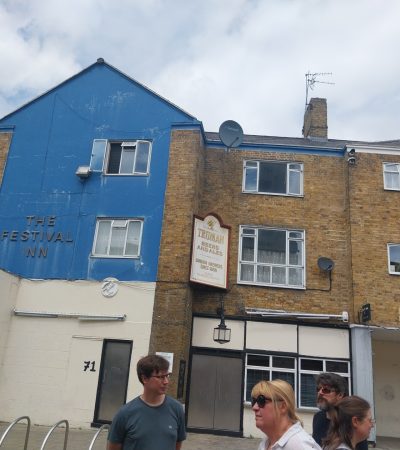
During the Second World War, nearly a quarter of Poplar’s buildings were destroyed or severely damaged because of the area’s proximity to London’s docks.
Inspired by the 1943 Abercrombie County of London Plan and Ebenezer Howard’s Garden City Movement, planners wanted to replace overcrowded and unhealthy housing with welcoming neighbourhoods designed around people rather than traffic.
Their vision included:
- Low-rise housing
- Schools
- Churches
- Shops
- Parks and open spaces
- Safe pedestrian walkways
- Community facilities
The aim was simple: create homes fit for heroes and rebuild stronger communities.
The Lansbury Estate as a Living Exhibition
In 1948, planners chose the Lansbury Estate to become something extraordinary: a 30-acre “Live Architecture” exhibition for the 1951 Festival of Britain. Instead of asking visitors to imagine modern housing through models and drawings, they invited them to walk real streets, peer into real homes and experience a new kind of neighbourhood taking shape around them.
This was not a temporary showpiece to be dismantled once the bunting came down. The houses, schools, churches and community spaces on display were designed to be lived in long after the Festival ended, providing a permanent home for thousands of Londoners. Even though construction was still underway when the Festival opened, visitors could wander the half-finished estate, watching streets, squares and green spaces emerge from what had been war-damaged streets. For many, it felt like stepping into a working blueprint for Britain’s urban future.
A Blueprint for Britain's Future Housing
The estate was designed by a team of leading architects and planners, including Geoffrey Jellicoe and Judith Ledeboer, who were determined to show how modern housing could be both practical and humane. They were not just drawing up a new estate; they were sketching out how post-war Britain might live, work and socialise in the decades to come.
At the heart of the Lansbury plan was the idea of a complete neighbourhood. The masterplan brought together a mix of features that would meet everyday needs within walking distance:
- Different housing styles, from flats to maisonettes and houses, to suit a range of family sizes
- A new shopping centre, with everyday services close at hand
- The rebuilt Crisp Street Market, preserving local trading traditions within a modern setting
- Schools for children growing up in the new community
- Churches and a church hall as spiritual and social anchors
- Public parks and small greens threaded between the buildings
- Shared community spaces and pedestrian-friendly routes
The estate was intended to house between 6,000 and 10,000 residents, forming a genuinely self-contained community rather than just a collection of blocks. The aim was that a family could live, shop, worship, play and go to school all within the same carefully planned landscape, offering a model for how other bomb-damaged districts across Britain might be rebuilt.
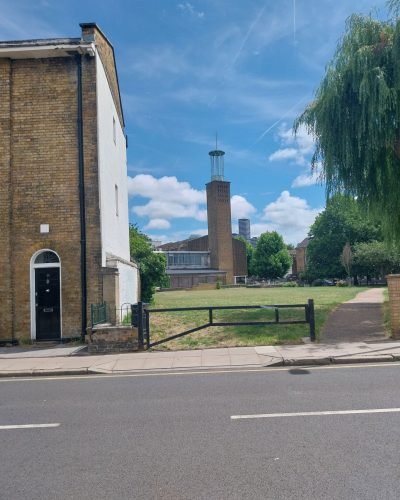
More than 86,000 visitors, including King George VI and Queen Elizabeth (later the Queen Mother), toured the estate during the Festival.
Although this was far fewer than the eight million visitors to the South Bank, many visitors were architects and planners who later applied these ideas across Britain.
What Residents Thought
Not everyone was impressed with the Lansbury Estate on paper. Some architectural critics dismissed it as plain, cautious or not quite bold enough for a showcase of modern design. Yet for the people who actually moved in, the experience was often very different.
Many families had come from overcrowded, damp homes without indoor bathrooms or toilets, where several people might share a single room and basic facilities were outside. Moving into the Lansbury Estate represented a dramatic improvement in comfort and dignity.
For residents, the key changes included:
- Modern, purpose-built homes rather than converted or ageing properties
- Indoor bathrooms and toilets, with hot water and better sanitation
- Separate kitchens designed for everyday family use
- Better natural light and ventilation
- Green communal spaces for children to play and neighbours to meet
- Safer, more ordered streets and pedestrian routes
Over time, people spoke warmly about:
- A strong sense of neighbourhood spirit
- Knowing their neighbours and feeling part of a community
- Pride in their new surroundings
- The contrast with the cramped, unhealthy conditions they had left behind
Sociologists Ruth Glass and John Westergaard, who studied the estate, found that most residents were not just content but strongly positive about their new homes. Their work offers a useful reminder that, whatever the critics thought, the Lansbury Estate made a real difference to the daily lives of the people who lived there.
From Low-Rise Living to High-Rise Development
The original Festival vision focused on low-rise neighbourhoods built around shared green spaces.
However, in 1951, Housing Minister Harold Macmillan announced a new direction for public housing that prioritised higher-density development.
As a result, taller tower blocks were gradually added to the estate, including Fitzgerald House, completed in 1968.
Although the development evolved over several decades, much of the original Festival vision survives today.
The Lasting Legacy of the Lansbury Estate
Unlike much of the Festival of Britain, which vanished once the pavilions were dismantled and the crowds dispersed after 1951, the Lansbury Estate remains very much part of London’s everyday landscape. It is a rare example of a Festival project that you can still walk through, live in and recognise as a product of that hopeful post-war moment.
Visitors today can still explore:
- Crisp Street Market, where the long history of street trading continues alongside post-war rebuilding
- Low-rise terraces, reflecting the original Festival vision of human-scaled housing arranged around shared spaces
- Community greens, small patches of grass and planting that break up the brick and concrete and offer places to sit, play and gather
- Early pedestrian shopping streets, designed to separate shoppers from traffic and encourage local, walkable retail
- Post-war architecture, with its mix of brick, concrete and careful detailing that speaks of a time when social housing was seen as a national priority
Taken together, these features make the Lansbury Estate one of London’s finest surviving examples of post-war planning and community-focused design. Walking its streets, you can still trace the ideas that shaped it: homes arranged around courtyards, routes that prioritise people over cars, and everyday amenities placed at the heart of the neighbourhood.
The estate remains a powerful reminder of Britain’s determination to rebuild after the Second World War and to create better places to live for ordinary families. It also invites us to reflect on how those ambitions have fared since, and what lessons this “hidden” Festival of Britain site might still hold for the way we plan and care for our cities today.
Conclusion
The Lansbury Estate is one of the hidden stories of the Festival of Britain. While the South Bank became the Festival’s iconic symbol, this remarkable East London neighbourhood became its most enduring physical legacy.
Designed around community, green spaces and high-quality housing, it influenced public housing developments across Britain and continues to demonstrate what thoughtful urban planning can achieve.
As the Festival of Britain marks its 75th anniversary, the Lansbury Estate deserves recognition as a living monument to post-war optimism and Britain’s vision for a better future.
Explore London's Festival of Britain Heritage
Discover the remarkable story of the Festival of Britain for yourself by joining one of our guided walking tours.
Our Festival of Britain Walking Tour explores the famous South Bank site, revealing the architecture, innovation and stories behind this landmark event.
You can also visit Pimlico on our Garden Village of Pimlico Walking Tour, where you’ll discover the post-war Churchill Gardens Estate and Lillington and Longmoore Estate—two outstanding examples of housing built in the same optimistic spirit that shaped the Lansbury Estate.
Book your walking tour today and experience London’s post-war history with Barbara Wright or one of our qualified guides.