Introduction: London's Most Compassionate Sculptor
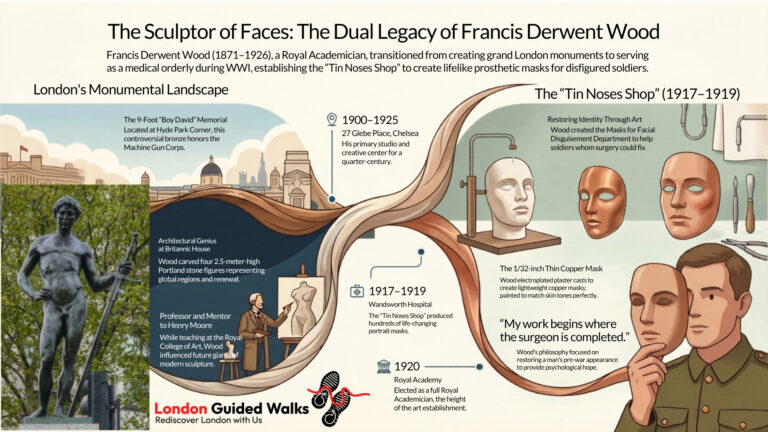
Stand at Hyde Park Corner today and you’ll see one of London’s most controversial war memorials: a nine-foot bronze statue of a youthful, naked David. Few passers-by realise that its creator, Francis Derwent Wood RA, was far more than a sculptor of monuments. He was the pioneering artist who gave hope back to the most disfigured victims of the First World War, working from a Wandsworth hospital room that soldiers affectionately nicknamed the “Tin Noses Shop”.
This guide traces Wood’s remarkable London life and works, from his Chelsea studio at 27 Glebe Place to the Machine Gun Corps Memorial at Hyde Park Corner, revealing how one sculptor combined artistic genius with extraordinary compassion to help hundreds of wounded soldiers rebuild their lives.
Early Life and London Training From Keswick to South Kensington
Francis Derwent Wood was born on 15 October 1871 in Keswick, Cumbria, but it was in London that he built his career and made his most enduring mark. After early training in Germany at the Kunstgewerbeschule in Karlsruhe, Wood moved to London in 1890 to study at the National Art Training School in South Kensington (later the Royal College of Art).
There he trained under the celebrated sculptor Édouard Lantéri, one of the finest modelling teachers of his generation. Just a year later, Wood was assisting Alphonse Légros at the Slade School of Fine Art, demonstrating the rapid trajectory of his early London career.
Royal Academy Success
In 1894, Wood entered the Royal Academy Schools while simultaneously working as an assistant to Sir Thomas Brock RA, one of Victorian Britain’s most celebrated sculptors. In 1895, he won the Gold Medal and Travelling Studentship for his sculptural group Daedalus and Icarus, which funded a year-long study trip to Paris.
By the time he was 25, Wood had established himself as one of London’s rising sculptors, combining classical training with individual artistic vision.
Wood's Chelsea Life: Glebe Place and Carlyle Square
27 Glebe Place: A Chelsea Studio (1900-1925)
In 1900, Wood established his studio at 27 Glebe Place, Chelsea SW3 – a location he would maintain for the next 25 years. This terrace of Victorian studio-houses in the heart of Chelsea’s artistic quarter became the centre of his creative life, surrounded by fellow artists, writers, and the vibrant community of the Chelsea Arts Club, of which Wood was a long-standing member.
Glebe Place today remains one of Chelsea’s most distinctive artistic streets, with several houses bearing blue plaques commemorating their distinguished occupants.
18 Carlyle Square: Family Home
By 1911, Wood’s improving finances – fed by portrait commissions, public statues, and architectural work – allowed him to purchase the lease on 18 Carlyle Square, Chelsea. He lived there with his wife Florence Mary Schmidt (married 1903) and their son until the year before his death in 1926.
This corner of Chelsea – bounded by Glebe Place, Carlyle Square, and the Chelsea Embankment – became Wood’s creative and domestic world for over two decades, placing him at the heart of London’s artistic establishment.
London's Architectural Sculptor: Britannic House and Beyond
Britannic House, Finsbury Circus (1921-1925)
Walking through the City of London today, you can still see Wood’s architectural genius in stone. His most significant London commission came when he collaborated with the legendary architect Sir Edwin Lutyens on Britannic House at Finsbury Circus, EC2.
Built between 1921 and 1925 for the Anglo-Persian Oil Company (later BP), the Portland stone building features four monumental sculptures by Wood – each 2.5 metres high – carved in situ on the corner set-backs:
- Britannia – helmeted, with shield and trident
- The Indian Water Carrier – representing India
- The Persian Scarf Dancer – representing Persia
- Woman with Baby (Spring) – representing renewal
Each sculpture is signed “DERWENT WOOD RA / 1924” and represents the global reach of imperial commerce at its height. Architectural historian Henry-Russell Hitchcock called Britannic House “Lutyens’s most successful big business building,” praising its “major Baroque drama”.
The building is now Grade II* listed and home to international law firm Stephenson Harwood.
Australia Gate, Buckingham Palace (c.1920)
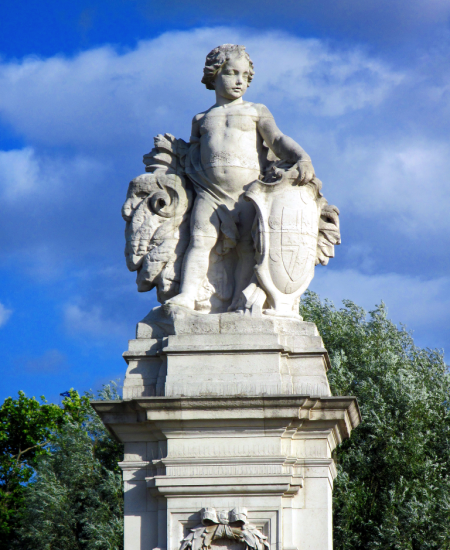
Wood also created sculptures for the Australia Gate at Buckingham Palace, SW1, part of the ceremonial gates erected around the Victoria Memorial. His stone figures of boys with kangaroo and sheep crown the gate pillars, representing Australia’s pastoral wealth.
The Third London General Hospital, Wandsworth: The 'Tin Noses Shop'
Enlisting as a Medical Orderly
When war broke out in 1914, Wood was 43 – too old for active combat. Instead, he enlisted as a private in the Royal Army Medical Corps, serving as an orderly alongside his photographer friend Ward Muir and painter C.R.W. Nevinson at the Third London General Hospital in Wandsworth, SW18 (now the Royal Victoria Patriotic Building, Fitzhugh Grove, Trinity Road).
The hospital’s Commanding Officer, Lieutenant Colonel H. Bruce Porter, quickly recognised Wood’s exceptional skills and appointed him to run the Plaster and Splints Department, promoting him first to Sergeant and then to Lieutenant.
The Masks for Facial Disfigurement Department
The mechanised weapons of the Great War – machine guns and modern artillery – inflicted facial injuries of a type and severity never seen before. An estimated 60,500 British soldiers suffered head or eye injuries during the war. Conventional medicine could do little; rubber masks were uncomfortable and unconvincing.
In 1916 or 1917, Wood opened the Masks for Facial Disfigurement Department at Wandsworth – a clinic that wounded soldiers affectionately called the “Tin Noses Shop”. The department employed three other sculptors in addition to Wood, plus a casting specialist and plaster mould-maker.
Wood's Revolutionary Technique
Wood articulated his philosophy in an article published in The Lancet in 1917:
“My work begins where the work of the surgeon is completed. When the surgeon has done all he can to restore functions… I endeavour by means of the skill I happen to possess as a sculptor to make a man’s face as near as possible to what it looked like before he was wounded.”
The process was painstaking:
- Photographs of the soldier’s pre-war face were obtained
- After all wounds and surgeries had healed, a plaster cast was taken of the damaged face
- Wood created a clay model, using the undamaged side as a guide to reconstruct missing features
- A final cast was electroplated to produce a thin copper mask (just 1/32 of an inch thick)
- The mask was painted with spirit enamels while the patient wore it, matching skin tone exactly
Ward Muir's Account
Wood’s colleague Ward Muir described the facial ward in his 1918 book The Happy Hospital in unflinching terms:
“Hideous is the only word for these smashed faces: the socket with some twisted, moist slit, with a lash or two adhering feebly, which is all that is traceable of the forfeited eye; the skewed mouth… and worse, far the worst, the incredibly brutalising effects which are the consequence of wounds in the nose.”
But Muir also captured the transformation Wood achieved:
“The squeeze, hitherto representing a face asleep, seems to awaken. The eye looks forth at the world with intelligence.”
Impact and Legacy
Though the ward operated for only two years (1917-1919) and produced an estimated several hundred masks – a tiny fraction of the 20,000+ men with facial wounds – the impact on individual lives was profound.
One soldier wrote to the ward:
“Thanks to you, I will have a home…the woman I love no longer finds me repulsive, as she had a right to do.”
American sculptor Anna Coleman Ladd visited Wood in London and established her own Studio for Portrait Masks in Paris under American Red Cross sponsorship, producing 185 masks before closing in early 1919.
Post-War Career: Professor and Royal Academician
Royal College of Art (1918-1923)
In 1918, Wood was appointed Professor of Sculpture at the Royal College of Art, a position he held until 1923. Among his pupils was a young Henry Moore, who would become one of the 20th century’s most celebrated sculptors.
Election to the Royal Academy (1920)
In 1920, Wood was elected a full Royal Academician (RA), cementing his place in the British art establishment at the age of 49.
War Memorials: Controversy and Commemoration
Canada's Golgotha (1919)
In 1919, Wood produced a controversial sculpture called Canada’s Golgotha (The Crucified Soldier)*, depicting a Canadian soldier crucified like Christ. The work caused “a diplomatic flap between the Canadian and German governments” due to its inflammatory imagery of German atrocities.
Machine Gun Corps Memorial, Hyde Park Corner (1925)
Wood’s most famous – and most debated – London war memorial stands at Hyde Park Corner, W1J 7NT. The Machine Gun Corps Memorial was unveiled by the Duke of Connaught on 10 May 1925.
The memorial features:
- A nine-foot heroic nude statue of David holding an oversized medieval sword
- Mounted on a grey marble column
- Flanked by two bronze Vickers machine guns garlanded with wreaths
The inscription reads: “Saul hath slain his thousands, but David his tens of thousands” – a biblical quotation that has provoked controversy since unveiling.
Critical Reception
Letters flooded The Times objecting to the triumphalist tone. One correspondent suggested the more apt biblical quotation would be David’s lament: “Oh my son Absalom, my son, my son!”
Historian Susan Beattie wrote scathingly in 1980:
“…the languorous nude David by Derwent Wood… commemorates, with sickening irrelevance, the dead of the Machine Gun Corps.”
Architectural historian Gavin Stamp noted in 2008 that Wood “had not served” in combat – though this overlooks his extensive war service at Wandsworth.
A Different Interpretation
The choice of David – the boy who triumphed over a greater force using a small weapon – was allegorical in a tradition stretching back through Donatello and Michelangelo. Wood, who had spent years restoring the faces of men shattered by machine guns, understood the weapons’ destructive power better than most.
The memorial was Grade II* listed in 2014 (upgraded from Grade II). An annual service of remembrance is still held at the Boy David Memorial.
Wartime Protection
During World War Two, the 67-ton memorial was partially dismantled. The statue of David and bronze machine guns were removed and stored in the disused Aldwych Underground Station from April 1940, returning on 5 March 1946.
The Atalanta Memorial, Chelsea Embankment
In 1929, three years after Wood’s death, friends from the Chelsea Arts Club commissioned a bronze cast of his 1909 marble Atalanta* to be erected on the Chelsea Embankement near Albert Bridge, SW3 as a memorial to him.
The sculpture depicts Atalanta, the virgin huntress of Greek mythology, in contrapposto. The original marble is now in Manchester Art Gallery.
Tragically, the original bronze was stolen in 1991. The sculpture that stands today is a 1994 replica. The original has never been recovered.
The memorial stands within sight of Wood’s old Chelsea haunts on Glebe Place and Carlyle Square, a fitting tribute in the neighbourhood he called home for 25 years.
Death and Burial
Francis Derwent Wood died on 19 February 1926 from lung cancer at 14 Henrietta Place, Westminster, aged just 54. The Times published his obituary the following day.
His estate at probate was valued at £10,155 1s 9d – a modest sum for a man of his standing, suggesting much of his income had been invested in his practice and war work.
He is buried in the churchyard of St Michael’s Church, Amberley, West Sussex, with a bronze cast of his relief The Lamentation* set into his headstone.
Why Francis Derwent Wood Matters to London
Francis Derwent Wood’s London legacy is visible across the capital in bronze, stone, and copper. From the grand imperial symbolism of Britannic House to the controversial heroism of the Machine Gun Corps Memorial, his works capture the confidence and contradictions of early 20th-century Britain.
But Wood’s most profound legacy isn’t cast in bronze at all. It lives in the faces – both real and reconstructed – of the hundreds of young men who walked out of that Wandsworth hospital room with their dignity restored, ready to face the world again.
Wood proved that sculpture could be more than monuments and memorials. In the hands of a compassionate artist, it could be medicine, psychology, and hope – giving back to broken soldiers not just the appearance of a face, but the courage to show it to the world.
Key Takeaways: Francis Derwent Wood Facts
- Born: 15 October 1871, Keswick, Cumbria
- Died: 19 February 1926, Westminster, London (aged 54)
- London Studio: 27 Glebe Place, Chelsea (1900-1925)
- London Home: 18 Carlyle Square, Chelsea (1911-1925)
- War Service: Private, then Lieutenant, Royal Army Medical Corps, Third London General Hospital, Wandsworth (1915-1918)
- Innovation: Created the ‘Tin Noses Shop’ – Masks for Facial Disfigurement Department (1917-1919)
- Masks Created: Several hundred portrait masks for disfigured WW1 soldiers
- Major London Works: Britannic House sculptures (1924), Machine Gun Corps Memorial (1925), Australia Gate (c.1920), Atalanta memorial (1929)
- Teaching: Professor of Sculpture, Royal College of Art (1918-1923); pupil included Henry Moore
- Honours: Royal Academician (1920)
Further Reading and Resources
- The Lancet (1917) – Wood’s own article on facial masks
- Ward Muir, The Happy Hospital (1918) – contemporary account of the ‘Tin Noses Shop’
- Susan Beattie, The New Sculpture (1980) – critical assessment of war memorials
- Victorian Web – comprehensive online resource on Derwent Wood’s works
- Public Statues and Sculpture Association UK – detailed catalogue of London sculptures
🎧Related podcast episodes:
🔊124: The History of Tite Street
🔊158: Finsbury Circus: From Marshland to Modern Metropolis
Visit Wood's London Works:
- Britannic House, Finsbury Circus, EC2 – Architectural sculptures (1920-25)
- Machine Gun Corps Memorial, Hyde Park Corner, W1 – War memorial (1925)
- Atalanta Memorial, Chelsea Embankment, SW3 – Memorial to Wood himself (1929)