The Victorian story of theatre life, treachery and ghostly goings on at the Adelphi Theatre, London.
Join Hazel Baker as she tells the tale of one of the most renowned actors of the era, William Terriss, and his untimely demise.


Your Host: Hazel Baker
Hazel is an active Londoner, a keen theatre-goer and qualified CIGA London tour guide.
She has won awards for tour guiding and is proud to be involved with some great organisations. She is a freeman of the Worshipful Company of Marketors and am an honorary member of The Leaders Council.
She has been an expert guest on Channel 5’s Walking Wartime Britain (Episode 3) and Yesterday Channel’s The Architecture the Railways Built (Series 3, Episode 7).
Hazel Baker: Hello and welcome to London Guided Walks London History podcast. In the coming episodes, we will be sharing our love and passion for London, its people, places and history in an espresso shot with a splash of personality. For those of you who don’t know me, I am Hazel Baker, founder of London Guided Walks, providing guided walks and private tours to Londoners and visitors alike.
We have officially entered the spooky season. Last year, I shared with you a Georgian Ghost story in Episode 28. This year, I want to share with you the story of the life and death of one of the most respected of Victorian actors, William Terriss. Yes, you heard me correctly, life and death.
If you’re not into ghostly stories, don’t worry, I’ll be focusing more on the development of the Adelphi theatre up until 1897. And also, the life of this celebrated Victorian actor. It’s such a shame that what he worked so hard for and was similarly so good at, is not for what he’s known for best – being a ghost!
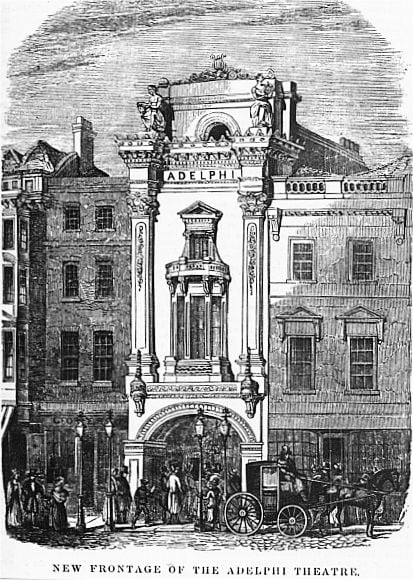
The London theatre that is most commonly associated with the actor William Terriss is the Adelphi on The Strand. The grade two listed art deco building that you see now is the fourth version having initially been built in 1806 with rebuilds done in 1858, 1900 and 1930.
The first theatre, built in 1806 was founded by John Scott who had made his money with the invention of a washing blue called ‘Old True Blue’, a technique for whitening clothes, as well as selling magic lanterns in his shop on the Strand. He was able to obtain a ‘burletta license’, which gave him permission to put on plays with music.
The theatre was built at the back of his shop and opened with the name, “Sans Pareil” to showcase his daughter’s theatrical talents.
The theatre was a success so much so that Scott enlarged the auditorium in 1813- 14 and built a columned portico on the Strand.
In 1819, he sold the theatre and it was renamed the Adelphi after the impressive complex on the opposite side of the Strand, built by the brothers, Robert and James Adam from 1768. The name Adelphoi in Greek means “the brothers”.
Among the celebrated actors who appeared on its stage was the comedian Charles Matthews whose work the young Charles Dickens admired so much.
Building on its continued success the front of the Adelphi was rebuilt to the designs of Royal Lyceum architect, Samuel Beasley in 1840. Surrounding buildings were acquired, which allowed the stage size to be increased and boxes to be added in the auditorium.
The early 19th century was a really exciting time for theatre goers as not only was the number of venues increasing, but so too was the type of productions available.
The Adelphi has the distinction of being the first house to stage an adoption of a work by Charles Dickens. And that being a comic burletta (a farce) called ‘The Christening’, which opened on the 13th of October 1834. And that’s based on ‘The Bloomsbury Christening’, which would eventually be published in the first volume of Sketches by Boz.
In 1843, Parliament finally changed the licensing laws, which now allowed all theatres to stage “straight plays”, something that had been restricted to the two winter theatres, Covent Garden and Drury Lane, and they’d benefited from a duopoly granted in the 17th century.
The three-tier auditorium we expect to see in a West End theatre was added in 1858 to allow now an audience capacity of 1,400. Not bad from what started as a back room of a shop eh?
This version of the Adelphi theatre is what William Terriss would have been familiar with.
In 1878 restaurateur brothers, Agostino, and Stefano Gatti bought the theatre license and after acquiring adjacent buildings opened ‘The Adelphi Theatre Restaurant’, a first-class restaurant in 1887. You can learn more about the Gatti brothers and their uncle Carlo Gatti on my Victorian Covent Garden walk.
During the time William Terriss performed at the Adelphi in 1897, it had already gained and maintained a reputation as the home of melodrama and was connected to names such as Madame Celeste, Fredrick Henry Yates, Mrs Keeley and Paul Bedford.
So, let’s get to know William Terriss a little bit better.
On Saturday 20th of February, 1843 William Charles James Lewin was born into a semi wealthy family to barrister George Herbert Lewin and his wife, Mary.
In a Georgian house at seven circus road, St. John’s wood NW8, his father died when he was 10 years old after attending a number of schools and then having to leave due to bad behaviour, admittedly, his final school, he actually ran away from, it was put to him that a career in the merchant navy may suit. The idea appealed to the young man and so off, he went to sea in his very fetching midshipman uniform. Within two weeks, his mother received a telegram from William who had slipped ashore in Plymouth saying he had found that life at sea did not live up to expectations and he was on his way back home already. His family then sent him to Assam in India for a new job, with a firm of tea planters, but like a boomerang William came back. But now with stories of shipwrecks and endless days under the unforgiving sun to entertain his sisters with.
William’s next adventure abroad was when he was 18. He was invited on a short Mediterranean cruise with his godfather, John Henry Graves, who was to accompany a wealthy friend. He donned his little worn Naval uniform and joined the party who had hired a special train carriage attached to the night mail from Paddington. During the journey, William was given more attention than he was used to. The reason for this special attention became clear when they had reached the Royal Bath hotel, where they were to spend the night. Word had gotten out that William was in fact Prince Alfred, Queen Victoria’s second son, who was, at the time in the Navy. William loved it. His ego fully inflated, local dignitaries visited, and after breakfast, the next day, a large crowd had gathered to see the young prince off.
William played his part well, he smiled and waved at the adoring crowd and accepted small gifts from bouquets and perfume. Within a few weeks, William had returned, the cruise had been an absolute success. There’s a wonderful book called final performance by Ruth Sylvester. And it is a true story of love, jealousy, murder, and hypocrisy, and it is about William Terriss and in there, she includes a story about how the two brothers seem to have a very special relationship. William had an older brother called Bob who had completed his doctor training at St. Mary’s hospital in Paddington.
One day, the brothers were on a train going into Charing Cross sitting opposite one, another William cheekily winked at his brother who groaned inwardly. What? Now? William closed his eyes. He then began to twitch, which increased into a convulsion. Bob begged his brother to stop making a scene, but this epileptic fit grew worse. “He needs a doctor if you ask me”, said a woman passenger indignantly, “I am a doctor” Bob cried. He took his fitting brother off the train at the next stop. “You unfeeling brute” the woman exclaimed as the train pulled away, William collapsed into a heap on the platform in hysterics.
And if you enjoyed that, I’ll include a link to the book in the show notes.
William was theatrically gifted. His first experience of treading the boards was when he was 20 years old. He had been given three lines in St. Mary’s hospital, dramatic society’s production of William Barnes Rhodes “Bombastes Furioso” which had premiered at the Haymarket theatre in 1810.
William had had his first taste of acting and he liked it.
His first professional performance was in Birmingham and by the time he had returned to London, he was now William Terriss.
Terriss made his first London appearance as Lord Cloudways in a revival of the comedy drama “Society” by Thomas William Robertson on Monday 21st of September 1868 at the Prince of Wales Theatre, Coventry Street, (the road that links Piccadilly Circus with Leicester Square).
He was tall and handsome and had the perfect physique to play lead roles, such as Robin Hood, Ivanhoe, Romeo, and Nicholas Nickleby. He had a fine voice too and a friendly demeanour. He quickly became one of Victorian Britain’s most popular actors.
As well as being a top actor, he was something of a local hero having received the medal of the London Humane society, by rescuing people from drowning many times and was also a kind generous man sending money to the actor’s benevolent fund
In 1897 Terriss and a bit-part Scottish actor by the name of Richard Archer Prince had become acquainted.
Terriss helped the struggling young actor to find work in various productions that he had a hand in. However, Prince had in the intervening years become a bit mentally unstable and had gained the nickname “Mad Archer”. During the run of ‘The Harbour Lights’ in which Terriss starred and Prince had a minor role, Terriss took offence to something that Prince had said about him and had Prince dismissed. Terriss however, sent small sums of money to Prince via the actors’ benevolent fund and continued to try and find him acting work.
Lacking star quality, Prince was running out of options. He had lost everything. He had increasingly blamed Terriss for the hardship he suffered and decided to erase what he considered to be his competition.
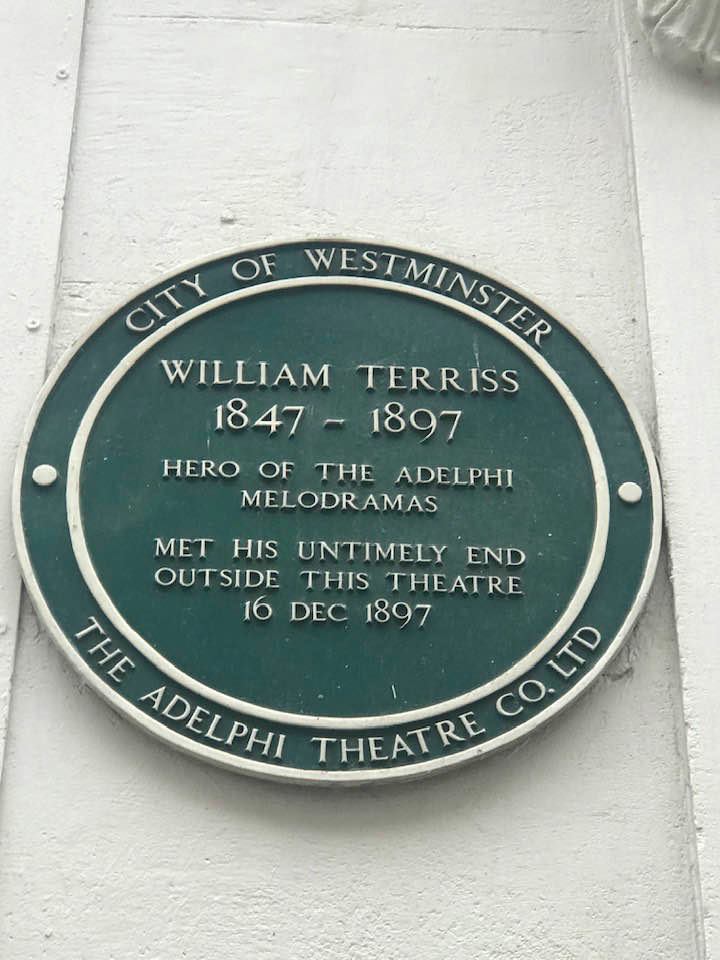
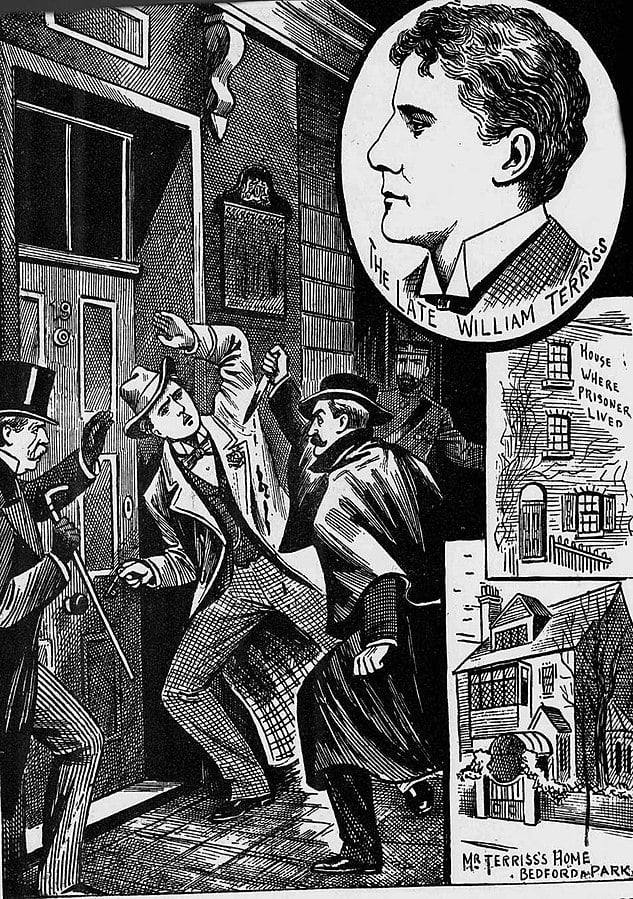
Sadly, the career of “Breezy Bill” as Terriss was known, was cut short on Thursday, the 16th of December 1897, just before the evening performance of an English version of William Gillette’s drama, “Secret Service” at the Adelphi Theatre.
Terriss was stabbed three times at the stage door of the Adelphi theatre and he staggered backstage and said, “I have been stabbed”. Doctors from Charing Cross hospital and the police soon arrived. Terriss’s friend Greaves had caught hold of the assailant who did not resist. It was Prince. In his pocket police found the bloody kitchen knife. He told police “I did it for revenge. He had kept me out of employment for 10 years and I had either to die in the street or kill him.” Terriss died shortly afterwards in the arms of his leading lady and mistress, Jessie Millwood. William Terriss had died at the height of his fame aged 50 years old.
The country mourned. On 21st of December 1897, an estimated crowd of 50,000 people lined the route of the funeral procession from Bedford Park to Brompton cemetery. And it consisted of over a hundred carriages. All the leading theatrical personalities were present; the Bancrofts, Sir Henry Irving, Mr. Seymour Hicks (the deceased’s son-in-law) Mary Anderson and Lily Langtry to name but a few. The Prince of Wales was amongst those who sent a wreath, his being that of white lilies and orchids.
The trial at the old Bailey was tabloid fodder. Prince was indicted for, and charged on the Coroner’s inquisition with the wilful murder of William Charles Lewin. The general consensus was that he was to go to the gallows, but the judge deemed Prince was not responsible for his own actions and was sentenced to life imprisonment in Broadmoor criminal lunatic asylum, where he died in 1936 at the age of 71.
The Adelphi Theatre was not the last of Terriss’s final performance. Oh no. There have been numerous reported appearances by his ghost.
The actor, June Howard Trip, starring in the musical ‘Clowns in Clover’ in 1928, reported that the couch in her dressing vibrated and that she felt a ghastly grip on her arm. Theatregoers that night also spoke of a green light manifesting on stage.
He has also been seen at Covent Garden tube station. A curious place for him to be I think, given that the station wasn’t built until 1907. There have also been a number of papers regarding visitations made by the spirit of Terriss to Ghost Club members as reported by the British library. And I’ll leave the link for you in the show notes to follow those through.
A portrait of William Terriss still hangs in the staircase of Denville Hall, the home for retired actors and actresses in Northwest London.
You can visit Terriss’s rather simple grave at Brompton cemetery. I’ll put the exact details into the show notes too. Remember to look for William Charles James Lewis, rather than his stage name.
William Terriss’s love for the theatre continued after his death, his daughter Ellaline Terriss, Mrs. Seymour Hicks, was a well-known actress in musical comedy. She and her husband, Edward Seymour Hicks, were proprietors of the Aldwych and Hicks’s theatres in London.
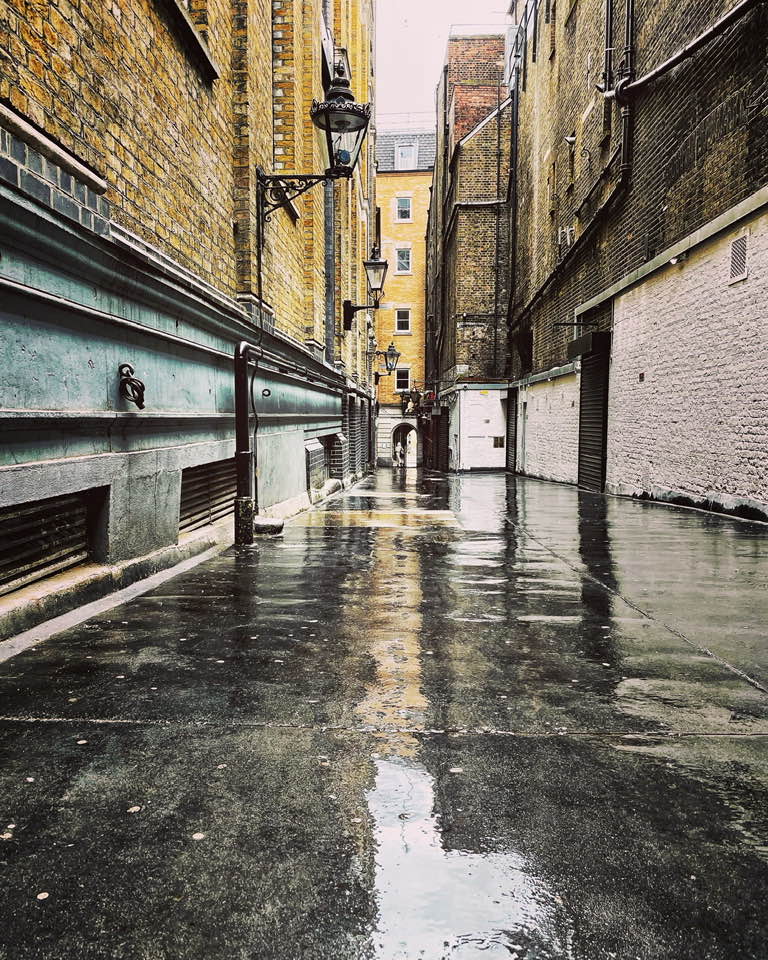
So, if you walk about the streets of Covent Garden at night, pay special attention around Covent Garden station and also Bulls Inn court, which is at the side of the Adelphi theatre.
And if you see anything, then let me know.
That’s all we’ve got time for now, but if you like music and theatre, then maybe you’ll enjoy Episode 17: The Proms and the Royal Albert Hall and for all you Victorian aficionados, there may be Episode 18: Victorian Photographs, Episode 29: Victorian Harp Makers or Episode 40: Charles Dickens in Greenwich will be right up your street.
And if you’re in London, then come and join us for a guided walk or indeed a private tour. So, we can really help you rediscover your love of London and its history.
That’s all we got time for this week. Thanks very much. See you next time.