Introduction
Mary Seacole’s London life is a story of celebrity, struggle and faith centred on Soho Square, Marylebone and Kensal Green – and it gives us a powerful lens on Black Victorian London.
Mary Seacole in London: an overview
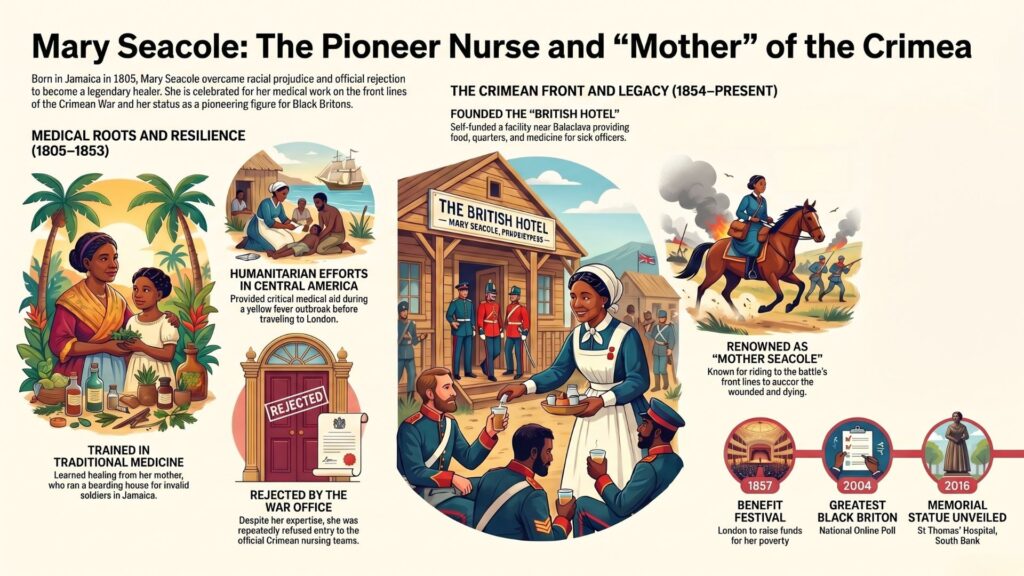
Jamaican‑born Mary Seacole became a household name in Victorian Britain for her work caring for British soldiers during the Crimean War. When she returned to London bankrupt in 1856, the capital became both the scene of her financial ruin and the stage on which she rebuilt her life through a bestselling autobiography, charitable festivals and a new religious identity.
London was where she crafted and controlled her own story, describing herself as “writer, hotel owner, doctress extraordinary” and insisting that “unless I am allowed to tell the story of my life in my own way, I cannot tell it at all.” Today, sites like 14 Soho Square, her Marylebone addresses, St Mary’s Catholic Cemetery at Kensal Green and the statue at St Thomas’ Hospital keep her London story alive in the city’s streets and skyline.
Soho Square: writing Wonderful Adventures
Around 1856–57, Seacole took a lodging in Soho Square, then a mixed commercial and residential square just off Oxford Street. From this central London base she wrote her memoir, Wonderful Adventures of Mrs Seacole in Many Lands, published in July 1857 and soon regarded as a Victorian bestseller.
The Museum of London notes that “around this time, Seacole was also writing her autobiography from her home in Soho Square,” placing her as a working author in the heart of the city’s literary and theatrical district. English Heritage adds that she is “commemorated with a blue plaque at 14 Soho Square, where she started writing her autobiography,” a detail that lets us fix her creative labour to a specific facade still visible today.
In Wonderful Adventures, Seacole uses London as a contrastive backdrop: “In my country, where people know our use, it would have been different; but here (England) it was natural enough that they should laugh, good‑naturedly enough, at my offer…” That line shows her navigating both opportunity and condescension in the metropolis, acknowledging that English officials “laughed” at her attempts to volunteer, even as she persisted in pushing for a role in the war effort.
Rejection, racism and the road to the Crimea
Before she departed for the Crimea, Seacole’s London efforts met with repeated refusal, which she describes in one of the most quoted passages of her book. She recalls an interview “with one of Miss Nightingale’s companions” who, she believed, would never have chosen her “had there been a vacancy,” adding: “Was it possible that American prejudices against colour had some root here? Did these ladies shrink from accepting my aid because my blood flowed beneath a somewhat duskier skin than theirs?”
Those questions are voiced in and about London, as she shuttles between War Office corridors and charitable committees in the capital. They also give us a rare mid‑Victorian, first‑person account of racial prejudice within the city’s institutions, allowing modern readers to hear a Black woman explicitly naming “prejudices against colour” in an English context.
Despite these rejections, she refused to be excluded from the war effort. As one later summary puts it, “she got herself out to the war by her own efforts and at her own expense; risked her life to bring comfort to the wounded and dying soldiers; and became the first black woman to make her mark on British public life.” That “public life” was mediated through London newspapers, publishers and audiences, which is why so much of Mary Seacole’s legacy runs through this city.
London’s charity festival and the Surrey Gardens concert
Seacole returned to London from the Crimea financially ruined, having been unable to recoup the cost of the British Hotel’s stock once the fighting ended. In response, her supporters organised a large‑scale benefit festival at the Royal Surrey Gardens in Kennington, then a popular South London pleasure garden.
The Florence Nightingale Museum notes that “in the same year a number of distinguished officers organised a concert in aid of Seacole at Surrey Gardens Music Hall in London,” though “unfortunately, Seacole received very little money from this.” Another account describes how Crimean commanders Lord Rokeby and Lord Paget spearheaded the event and that “there were over 1,000 performers, and her name was ‘shouted by a thousand voices’.”
This Surrey Gardens concert was part charity, part spectacle and part assertion that the city should not abandon “Mother Seacole.” William Howard Russell, the celebrated Times war correspondent whose words now appear behind her statue at St Thomas’ Hospital, used the London press to insist: “I trust that England will not forget one who nursed her sick, who sought out her wounded to aid and succour them, and who performed the last offices for some of her illustrious dead.”
A London bestseller: Wonderful Adventures
Seacole’s autobiography, written in Soho and published in London, was both a financial lifeline and a reputational safeguard. The London Museum emphasises that “much of what we know about Seacole comes from her autobiography… an edition from 1857 is in our collection,” and that “still, her Wonderful Adventures was a bestseller.”
The book positions her as a global traveller with a distinctly London‑centric audience, recounting her journeys from Kingston to Panama and on to the Crimea, then back to the capital. Throughout, she adopts a witty, conversational tone – something that modern interpreters highlight – calling herself “writer, hotel owner, doctress extraordinary,” a persona that resonates especially strongly in a city filled with entrepreneurs and migrants.
Because she published in 1857, three years before her conversion to Catholicism, the autobiography is silent on her later religious life. This gap makes London parish archives and later Catholic commentary crucial for understanding the second act of her story.
Marylebone: later London homes
After the immediate post‑Crimea publicity faded, Seacole’s life in London shifted into quieter, domestic rhythms in Marylebone and Paddington. St Marylebone’s parish history records that she “ended her days in Marylebone, living at 40 Upper Berkeley Street, 147 George Street and 3 Cambridge Square,” all in the West End grid north of Oxford Street.
This cluster of addresses places her among mid‑Victorian terraces and boarding houses, within easy reach of London’s hospitals, parks and churches. A City of Westminster green plaque now marks George Street, while English Heritage’s blue plaque in Soho Square acknowledges her earlier London base, creating a mapped chain from Soho’s literary world to Marylebone’s residential streets.
Conversion to Catholicism in London
One of the least‑known aspects of Seacole’s life is her conversion to Roman Catholicism, which took place after she had become a London celebrity. Fr Stewart Foster, archivist of the Diocese of Brentwood, told Catholic News Agency that she “was received into the Church in 1860, at the age of 55,” adding that “it appears that she became a Catholic in England.”
Because this reception happened after she published Wonderful Adventures, Seacole left “no record of her reasons for embracing the Catholic faith, which was remerging in Britain after centuries of suppression.” Later Catholic commentators stress that “it meant a great deal to her,” even though we must infer this from her burial choices and the communities with which she associated.
Her conversion places a Jamaican‑born, mixed‑race woman into the heart of a resurgent London Catholic scene that included Irish migrants, continental religious orders and English converts. It also offers a striking counterpoint to the Anglican‑dominated image of Victorian Christianity that many visitors assume when they first think of nineteenth‑century London.
Kensal Green: St Mary’s Catholic Cemetery
When Seacole died in 1881, she died not in Jamaica but in London, and was buried in a distinctly London Catholic space. The Museum of London summarises it simply: “Seacole died in London in 1881 and was buried at St Mary’s Roman Catholic Cemetery in Kensal Green.”
Catholic News Agency gives more detail, noting that “when Seacole died in 1881, she was buried in St Mary’s Catholic Cemetery in Kensal Green, northwest London.” This cemetery, opened in the 1850s, served many central London parishes and remains an important Catholic burial ground, which means that Seacole’s grave is embedded in a broader landscape of Catholic memory in the capital.
Her gravestone, restored by the Jamaican Nurses’ Association in 1973, describes her as a “notable nurse who cared for the sick and wounded in the West Indies, Panama and on the battlefields of the Crimea,” a wording that links her global work back to a particular plot of London soil. For twenty‑first‑century visitors, Kensal Green is thus both a Victorian cemetery and a pilgrimage site for those interested in Black British history, nursing and Catholic heritage.
London memorials: plaque and statue
Seacole’s London legacy is now inscribed in metal, stone and bronze across the city. English Heritage’s blue plaque at 14 Soho Square, unveiled in 2017, commemorates her as “Jamaican nurse, heroine of the Crimean War,” and notes that she lived and wrote there.
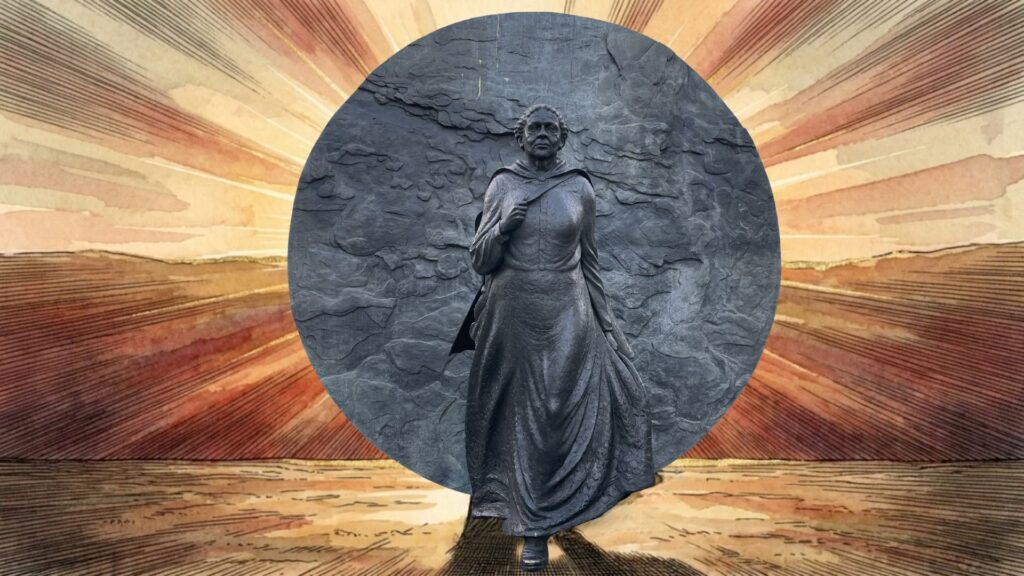
On the South Bank, a three‑metre bronze statue of Mary Seacole stands in the grounds of St Thomas’ Hospital, facing the Palace of Westminster. Historic England and other commentators observe that this memorial is “believed to be the UK’s first in honour of a named Black woman,” underscoring its symbolic importance in a city where imperial monuments have long dominated the skyline.
Behind the statue is a disk inscribed with William Howard Russell’s 1857 tribute: “I trust that England will not forget one who nursed her sick, who sought out her wounded to aid and succour them, and who performed the last offices for some of her illustrious dead.” That line was written by a London‑based correspondent for a London newspaper and now literally faces Parliament, closing a circle between Victorian print culture and modern public art.
Why Mary Seacole’s London life matters today
Mary Seacole’s London story connects Black Atlantic migration, women’s work, war, faith and memory in a single, walkable geography. From Soho Square, where she wrote a bestselling memoir and negotiated the city’s prejudices, to Marylebone terraces, a Catholic cemetery at Kensal Green and a pioneering statue at St Thomas’ Hospital, her life is written into the streets, churches and institutions of the capital.
For historians, educators and guides, her London years offer a way to talk about race and empire not as abstract forces but as realities lived out in specific houses, music halls, parish communities and hospital grounds. And for visitors, following Mary Seacole’s footsteps through London is a reminder that the city’s history has always been shaped by Black women as well as by the more familiar, marble‑clad figures of the Victorian age.
🔊Related Podcast Episode: