Introduction
If you know William Morris mainly as “the wallpaper man”, London is the best place to meet the rest of him – designer, writer, printer and political firebrand – all mapped onto real streets you can still walk today. For William Morris Day on 16 May, this guide explores how his story unfolds across Walthamstow, Bloomsbury and Hammersmith, and how you can experience it in person.
Who was William Morris and why does London matter?
William Morris was born in 1834 and became one of the most influential figures in the Arts and Crafts movement, famous for richly patterned wallpapers and textiles. But behind the motifs was a man deeply concerned with how things were made, who made them, and how industrial capitalism was reshaping Victorian life – especially in London.
What makes his story so powerful for visitors is that many of the key places from his life still exist: a teenage home now turned gallery in Walthamstow, a riverside house in Hammersmith, and the neighbourhoods where he ran workshops, founded a private press and hosted radical political meetings.
Where did William Morris live in Walthamstow?
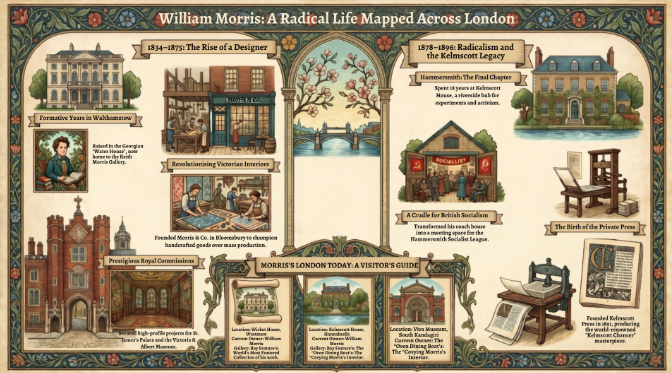
As a teenager Morris lived at Water House, a substantial Georgian villa set in grounds in what was then semi‑rural Walthamstow. Built in the 18th century, Water House is a symmetrical, brick-built home surrounded by parkland, and it offered young Morris a calm, carefully proportioned environment just as industrial London was expanding and darkening with coal smoke.
Today the house is better known as the William Morris Gallery, the only public museum in the UK devoted to his life and work. Inside you can see original wallpapers, textiles, furniture, printed books and political material which trace his journey from privileged youth to designer and socialist campaigner, all within the very building where he spent his formative years.
What can you see at the William Morris Gallery?
The William Morris Gallery presents his story thematically, covering design, crafts, printing and politics, and it often hosts temporary exhibitions that connect his ideas to contemporary makers. Collections include early hand‑printed wallpapers, embroideries, stained glass designs and examples from the Kelmscott Press, alongside letters and documents that illuminate his beliefs about work, art and social justice.
Outside, Lloyd Park offers a chance to step back and imagine the landscape that once surrounded Water House, before the arrival of modern transport and dense housing. For visitors interested in London history, it is a rare opportunity to stand in both a Georgian family home and a modern gallery at the same time, seeing how the building has been reused rather than replaced.
How did Morris’s London career develop in Bloomsbury?
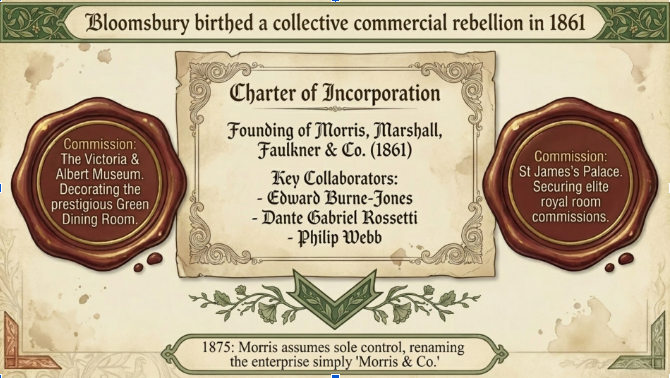
In the 1860s, Morris moved into central London and helped to found a decorative arts firm in Bloomsbury with artists such as Edward Burne‑Jones and Dante Gabriel Rossetti. Working at the heart of the city’s intellectual and commercial life, this firm – which later became Morris & Co. – designed stained glass, furniture, textiles and wallpapers that rejected cheap, machine‑made goods in favour of traditional craft techniques.news.
Their high standards quickly attracted prestigious commissions, including interiors at St James’s Palace and the Green Dining Room at what is now the Victoria and Albert Museum in South Kensington. These projects meant that Morris’s ideals about craftsmanship literally entered royal and national spaces, even as he became increasingly critical of the economic system that paid for them.knowyourlondon.
What is Kelmscott House in Hammersmith?
In 1878 Morris moved west to Hammersmith, leasing a large Georgian house beside the Thames that he renamed Kelmscott House. The brick-built, multi-storey property had long riverside gardens and views over the water, giving him both physical space and visual calm away from the crowded centre.
Kelmscott House became his main London base for the final 18 years of his life and is now Grade II* listed for its architectural and historic importance. Inside he worked on textile designs, conducted weaving and dyeing experiments, hosted friends and fellow thinkers, and eventually set up the Kelmscott Press, which transformed how late Victorian books could look and feel.programme.
Why is the coach house at Kelmscott important?
Behind the main house is the former coach house, once used for carriages, which took on a very different role in the 1880s. Morris became a committed socialist and helped to found the Hammersmith Socialist League, using the coach house as a base for lectures, meetings and debates on politics, labour and social reform.
Today the William Morris Society occupies the basement and coach house at Kelmscott House, running a small museum and events programme focused on his life and legacy. Visitors can see displays, attend talks and step into the very space where leading socialist and anarchist thinkers once argued about the future of Britain, giving the house a second life as a place of discussion rather than transport.
What was the Kelmscott Press and why does it matter?
In 1891, Morris founded the Kelmscott Press at Hammersmith, determined to apply his Arts and Crafts ideals to the printed book. He designed new typefaces, insisted on high‑quality handmade paper and close control of layout and decoration, drawing inspiration from 15th‑century European printing.
The most celebrated result was the Kelmscott Chaucer, a lavish edition of Chaucer’s works filled with intricate borders and 87 woodcut illustrations by Edward Burne‑Jones. Completed only a few months before Morris’s death in 1896, it is widely regarded as one of the finest books of the nineteenth century and a landmark of private press publishing.
Can you still visit William Morris sites in London today?
Yes – and that is what makes William Morris an ideal subject for a London day out or themed walking tour. In Walthamstow, the William Morris Gallery at Water House offers free entry, exhibitions and a café in the landscaped grounds of Lloyd Park, making it a strong starting point in north‑east London.
In west London, Kelmscott House in Hammersmith can be viewed from the riverside and the William Morris Society museum in the coach house opens to the public on selected days. Combined with a stroll along the Thames Path and a look at nearby historic terraces and pubs, it creates a vivid picture of how Morris lived and worked by the river.
Planning your William Morris Day in London
For William Morris Day on 16 May, one option is to begin at the William Morris Gallery in Walthamstow in the morning, giving yourself time to explore the collections and the park. After that, you can head into central London for a look at Morris-related interiors in major museums, before finishing on the river at Hammersmith with an exterior view of Kelmscott House and, if timings allow, a visit to the William Morris Society museum in the coach house.
Whether you are a design fan, a book lover, or simply curious about how one person used art to respond to a changing city, Morris’s London offers a rare chance to connect ideas, objects and places in a single day. Walking between Walthamstow and Hammersmith, you can quite literally follow the path from comfortable Georgian home, through creative workshop, to riverside laboratory and radical meeting place – all without leaving the capital.