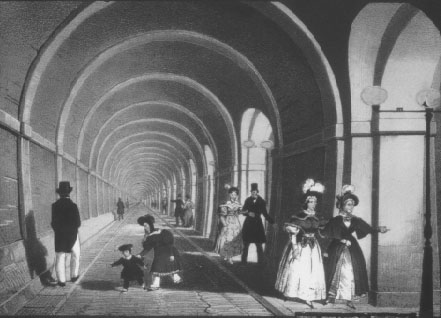
Marc Brunel Thames Tunnel: Engineering Marvels Unveiled

How Marc Brunel’s Thames Tunnel Was Inspired by the Teredo navalis

In the annals of engineering, the Thames Tunnel is a monument to ingenuity—a breakthrough inspired not solely by human intellect, but sparked by an encounter with one of the natural world’s unlikeliest engineers: the shipworm, Teredo navalis.

The Shipworm: Destroyer and Unexpected Muse

For centuries, Teredo navalis wrought havoc upon wooden ships and harbour structures throughout Europe and beyond. Known colloquially as the ‘naval worm’ or shipworm, this marine mollusc is not, in fact, a worm but a bivalve. From the Age of Sail onwards, wooden hulls infested with Teredo would quickly grow riddled with long tunnels, weakening their structure and hastening the loss of merchant vessels and naval warships alike.


The devastation was particularly apparent in the 17th and 18th centuries, as global sea trade expanded. Seafarers learned to fear these minuscule pests as much as storms or pirates: hulls, piers, and underwater pillars would, over a matter of months or years, be quietly honeycombed until they broke apart under strain.


Those who fought to keep ships intact tried copper sheathing, chemical treatments, burning—yet the shipworm’s secret methods of tunnelling and reinforcing its miniature burrow usually rendered human efforts only partially effective.


Ironically, it was this same destructive ability that would become a template for one of the greatest feats of Victorian engineering.

Marc Brunel’s Moment of Insight

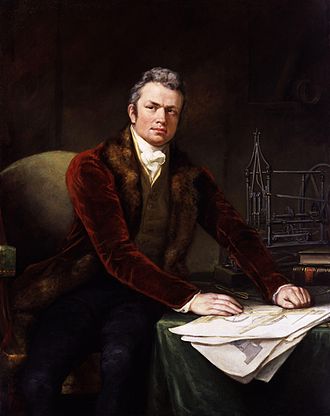
Portrait of Marc Isambard Brunel | Photo by James Northcote, Public domain, via Wikimedia Commons

Marc Isambard Brunel, a French émigré engineer working in Britain, came to know the shipworm while working at Chatham Dockyard. Fascinated by the natural world, he examined the timber planks infested with Teredo navalis and marvelled at the precision, efficiency, and structural integrity of the tunnels it left behind.


Unlike other forms of decay or marine pests, what impressed Brunel was the manner in which the Teredo protected itself—excavating as it advanced, and immediately lining its passage with a calcareous layer. This made the tunnel robust, allowing the shipworm to progress ever deeper through waterlogged, unstable wood without fear of collapse or flooding. Here, Brunel saw a biological solution for one of engineering’s most pressing challenges.

The Human Challenge: Tunnelling Under the Thames

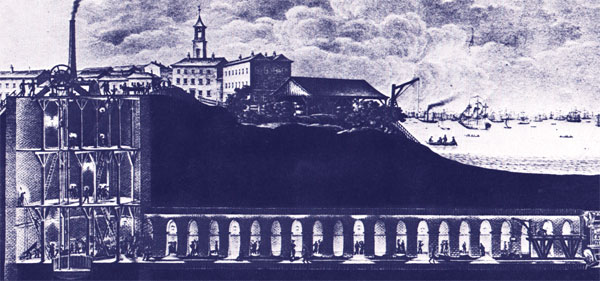
The Thames Tunnel excavation as it was, probably around 1840 | Photo by Taulman after Bonisch, Public domain, via Wikimedia Commons

To appreciate Brunel’s leap, it helps to understand the predicament faced by early Victorian engineers. The River Thames was vital to London’s prosperity, and its congestion posed a serious bottleneck for both commercial and everyday traffic. By the 1820s, ambitious plans were afoot to connect Rotherhithe and Wapping by means of a tunnel running beneath the riverbed, providing a passage untouched by tides, ice, or surface congestion.


However, the ground beneath the Thames was treacherous: a patchwork of mud, sand, gravel, and water-laden clay. It was notoriously unstable—liable to shift, collapse, and flood under pressure. Previous attempts at subaqueous tunnels (notably by engineer Richard Trevithick in the 1800s) had ended in catastrophic inundation, financial ruin, and loss of life.


Engineers of the time simply did not have a reliable method for working ahead of themselves and securing the tunnel as they went—a challenge not unlike burrowing through rotten, saturated timber.

From Shipworm to Shield: The Breakthrough

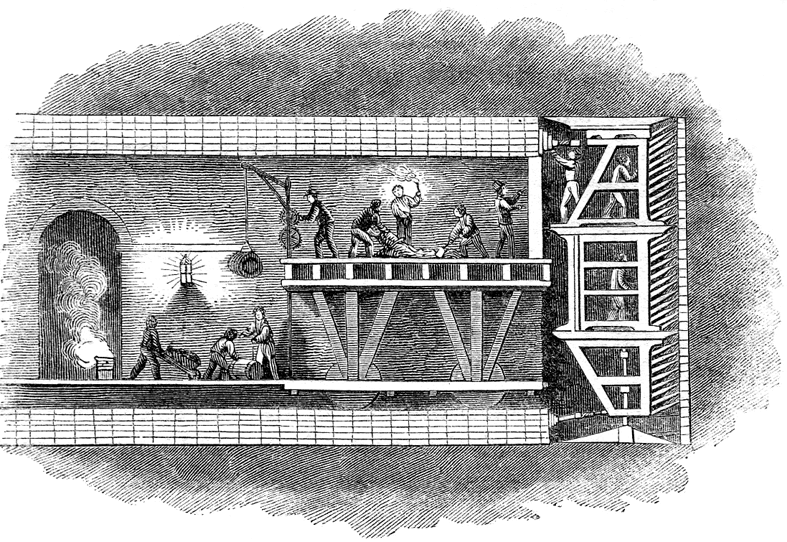
Drawing inspiration from the Teredo navalis, Brunel’s key innovation was the tunnelling shield, patented in 1818. It comprised a large iron structure with 36 separate cells, allowing miners to chip away at the face of the tunnel with protection on all sides. Critically, as each small section was excavated, bricklayers would immediately follow, lining and reinforcing the tunnel as work advanced—much as the shipworm lined its burrow.


The first driving of the shield began in 1825. The process was excruciatingly slow: at times, only a few centimetres a day were gained, with the shield inching forward as ground was excavated and bricked up almost simultaneously.

The shield in use during construction | No information for the author, Public domain, via Wikimedia Commons

Titanic Struggles and Dogged Perseverance

The Thames Tunnel’s construction turned into a monumental struggle against natural forces. Severe flooding occurred in 1827 and again in 1828, nearly drowning the workmen and temporarily halting the project. The water pressure could breach the delicate work face in minutes. Toxic gases, subsidence, equipment failures, and financial crises all conspired to delay progress.


At the heart of the tunnel’s survival was the shield’s modular, mobile protection—directly echoing the evolutionary adaptations of the Teredo navalis. Workers would press ahead, shielded from impending catastrophe, able to secure their gains in brick and mortar as they went. It was not brute force but an incremental, self-protecting advance—inspired wholly by nature’s methods—that saw the project through.


The final brick was laid in 1843, completing the world’s first tunnel ‘under’ a navigable river and making possible the South London and East London railway links decades later.

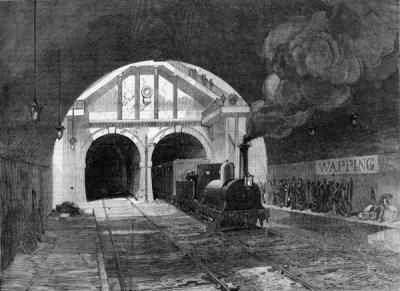
An 1870 view of a train exiting the Thames Tunnel at Wapping | Photo by Illustrated London News, Public domain, via Wikimedia Commons
Thames Tunnel | Photo by wikipedia.org/wiki

The Enduring Legacy of Nature-Inspired Engineering

Marc Brunel’s tunnelling shield paved the way for the tunnel boring machines (TBMs) now used worldwide, their rotating heads, conveyor systems, and sealing mechanisms designed to conquer soft and unstable ground by precisely the same principle first discovered in a worm-eaten plank.

Today, whenever a new tube, sewer or railway tunnel is dug beneath a city or waterway, it is part of Brunel’s intellectual inheritance—his ability to recognise the solutions that nature had trialled over countless generations.

Marc Brunel transformed the bane of shipowners into the salvation of civil engineers, showing how open-minded observation can drive technological progress. The Thames Tunnel is, in a sense, an architectural fossil—a proof that when human ingenuity and the lessons of nature meet, storms may be weathered and seemingly impossible challenges overcome.

Inspired by a worm, realised by a man—London’s Thames Tunnel is nature’s own principle, baked into brick and iron, at the heart of the city’s underground. Listen to Episode 137: The Thames Tunnel to find out more.

Facebook
Twitter
LinkedIn

Related Posts

Victorian 1837 - 1901
admin

Robert Burns Statue in London

As Halloween approaches, the supernatural notion of witches abroad beneath a full moon while the clock strikes midnight comes to mind. There is no finer

Read More »
Scroll to Top