Welcome to the London History Podcast. I am Hazel Baker from London Guided Walk co uk. Discover the remarkable story of Mary Harris Smith (1844–1934), London-born accountant and feminist campaigner, who became the world’s first female Chartered Accountant. From her early life in Kingsland/Dalston to decades of pioneering work in the City of London, she challenged male-dominated professional barriers, faced repeated rejection by the ICAEW, and paved the way for women in finance after the Sex Disqualification (Removal) Act 1919.
 Hazel Baker is an active Londoner, a keen theatre-goer and qualified CIGA London tour guide.
She has won awards for tour guiding and is proud to be involved with some great organisations. She is a freeman of the Worshipful Company of Marketors and am an honorary member of The Leaders Council.
Channel 5’s Walking Wartime Britain(Episode 3) and Yesterday Channel’s The Architecture the Railways Built (Series 3, Episode 7). Het Rampjaar 1672, Afl. 2: Vijand Engeland and Arte.fr Invitation au Voyage, À Chelsea, une femme qui trompe énormément.
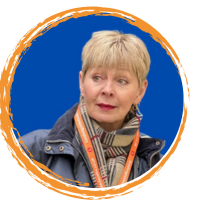
Guest: Jenny Funnell
Jenny Funnell is a qualified City of London Guide with a passion for sharing the stories that bring the Square Mile to life. For Jenny, guiding is more than a profession—it is a calling. She delights in introducing both visitors and locals to corners of the City they may never have noticed, revealing layers of history that sit behind its streets and buildings.
Her approach goes beyond landmarks to focus on the human stories woven into the fabric of this ancient City. Whether exploring grand architecture or the lives of the people who shaped London through finance, politics, and culture, Jenny offers tours that are both wide-ranging and richly engaging. She is particularly interested in the individuals whose achievements left a lasting mark on the City, bringing their experiences vividly into the present.
In this episode, Jenny joins the discussion of Mary Harris Smith’s groundbreaking career, helping to place her achievements within the wider story of the City of London and its evolving professional landscape.
Mary Harris Smith (1844–1934)
World’s First Female Chartered Accountant
Overview
Mary Harris Smith (27 November 1844 – 13 October 1934) was a London-born accountant, entrepreneur, and feminist campaigner who became the world’s first female Chartered Accountant and the first female member of the Institute of Chartered Accountants in England and Wales (ICAEW) in 1920.
Her career illustrates both the practical competence of women working in Victorian finance and the institutional barriers that kept them outside the pro
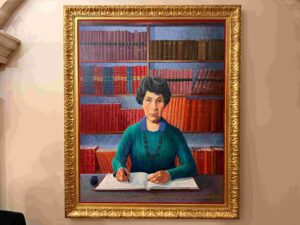
Portrait of Mary Harris Smith at ICAEW | Photo by Hazel baker
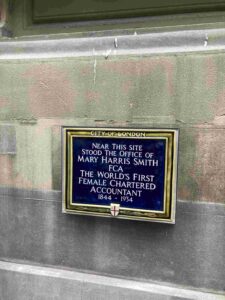
MHS plaque at ICAEW | Photo by Hazel Baker
Early Life and Education
Mary Harris Smith was born in Kingsland, London (near modern Dalston) to Susanna and Henry Smith in November 1844. Her father was a clerk to a navy agent and banker, and it was in helping him with bookkeeping work brought home that she first developed an interest in accounts.
By age sixteen she was already receiving advanced mathematical education:
- She studied mathematics at King’s College School under a master, unusually rigorous training for a girl at that time.
- She then attended some of the earliest bookkeeping classes organised by the Society for Promoting the Employment of Women (SPEW) around 1860, one of the pioneering organisations opening clerical and professional pathways to women.
This combination—practical experience in her father’s financial work plus formal mathematical and bookkeeping training—gave her the technical foundation to function at a professional level in a field that formally excluded her.
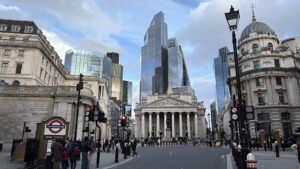
Bank Junction January 2026 | Photo by Hazel Baker
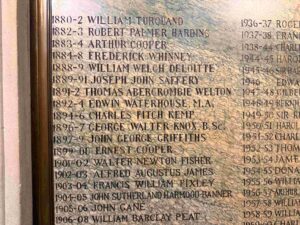
Charles Fitch Kemp | Photo by Hazel Baker
Early Career in Accounting
After her training, Mary Harris Smith entered the City of London commercial world:
- She worked for a mercantile firm in the City for approximately nine years as an accountant.
- She then became accountant to the Royal School of Art Needlework, a significant arts-and-crafts institution patronised by upper- and middle-class women.
- Her reliability and competence produced word-of-mouth demand: she was frequently requested to audit the accounts of other organisations, effectively running an external audit practice decades before she had any institutional status.
Even at this stage, she was functioning in roles equivalent to those of male professional accountants—internal accounting, external auditing, and advisory work—without the title or recognition.
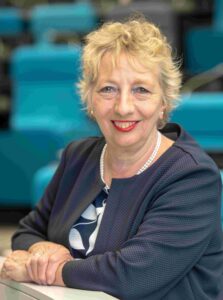
Fiona Wilkinson, ICAEW President in 2019/2020, the centenary of the admission of the first female member
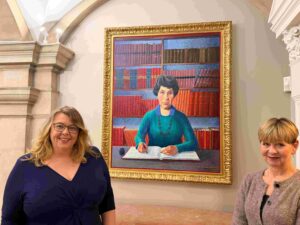
Portrait of M Harris Smith with Hazel and Jenny at ICAEW
Founding Her Own Practice
In 1887, Mary Harris Smith moved decisively into independent practice:
- She opened her own firm initially in Westminster, later in the City, trading as “M. Harris Smith, Accountant and Auditor.”
- In women’s periodicals she sometimes styled herself explicitly as a “lady accountant” to signal approachability to female clients, but in professional and mixed contexts used the gender-neutral “M. Harris Smith,” an early form of strategic self-branding.
- Contemporary advertisements described her as a “duly qualified ACCOUNTANT and AUDITOR of many years’ experience”, emphasising competence rather than novelty.
By the late 1880s she therefore had what we would recognise as a full public practice: bookkeeping, auditing, and financial advisory work for multiple organisations, on a fee-earning basis, from offices in central London.
Struggle for Professional Recognition
Attempts to join professional bodies
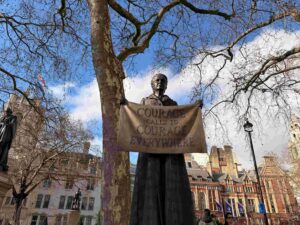
Millicent Garrett Fawcett | Photo by Hazel Baker
Despite her evident success, formal recognition was blocked by gendered rules of the nascent accountancy profession.
- Society of Accountants and Auditors (SAA / later SIAA)
- In November 1887 she applied for membership of the SAA (later the Society of Incorporated Accountants and Auditors).
- The Council discussed her case but the president effectively blocked admission; a subsequent motion on the admission of women was rejected in May 1891.
- The society’s secretary told her that “matters were not so bad” because she had not been “positively refused”, but in practice, no change occurred.
- Institute of Chartered Accountants in England and Wales (ICAEW)
- In July 1891 she applied to become a fellow of ICAEW.
- The Applications Committee recommended her for admission, acknowledging her experience and standing.
- However, the Institute’s solicitors argued that, under the royal charter, only “males” were eligible. On this legalistic basis her application was rejected in November 1891.
- In 1896, she requested to sit ICAEW’s examinations, seeking to enter by the same route as male candidates, but was again refused.
Throughout this period she was also in contact with leading women’s rights activists:
- Emily Davies, a key figure in women’s higher education and a colleague within SPEW circles, raised the question of women’s admission to professional bodies in the early 1890s, partly inspired by Harris Smith’s case.
- Millicent Garrett Fawcett, leader of the constitutional suffrage movement, is referenced in correspondence about “Miss Harris Smith” as an example of a woman clearly competent to be a professional accountant but denied credentials.
Motivations and public stance
Crucially, Mary Harris Smith framed her campaign not as a personal grievance but as a test case:
- She insisted that her object “was not for pecuniary gain, but to show that the ‘weaker sex’ was capable of doing as well in accountancy as men.”
- In 1895 she was quoted as saying: “Require of me what you would require of a man and I will fulfil it.”
This language matters for interpreting her as both professional and political actor: she was deliberately challenging the credentialing monopoly that underpinned male professional exclusivity.
Breakthrough: Legal Change and Admission
The decisive change came not from within the profession but via statute.
Sex Disqualification (Removal) Act 1919
In the context of women’s war work and suffrage gains, the British Parliament passed the Sex Disqualification (Removal) Act 1919, which prohibited excluding individuals from civil or judicial office, professions, or universities on grounds of sex.
This had two specific effects in her case:
- The Society of Incorporated Accountants and Auditors changed its rules to admit women and, in 1919, granted Mary Harris Smith Honorary Fellowship, officially dating from 12 November 1919.
- ICAEW could no longer legally bar women from membership purely on sex.
Becoming the first female Chartered Accountant
Mary Harris Smith moved quickly to capitalise on this opening:
- She renewed her application to ICAEW after the Act’s passage in 1919.
- In May 1920, at the age of 75–76, she was admitted as a Fellow of ICAEW (FCA), becoming ICAEW’s first female member and widely recognised as the world’s first female Chartered Accountant.
ICAEW’s own historical resources explicitly confirm:
- She was the first female ICAEW member and the first woman Chartered Accountant.
- She also appears first in ICAEW’s list of the first ten female Fellows, with both ACA and FCA dates recorded as 1920, underscoring the landmark status of her admission.
Newspapers and professional journals at the time also noted the milestone, and later scholarship places her at the centre of the “woman accountant’s movement” challenging patriarchal closure in the profession.
Later Career and Retirement
After gaining Chartered status, Mary Harris Smith continued working:
- She maintained her practice from offices in Queen Victoria Street, City of London, employing and training staff and advising clients.
- By the early–mid 1920s, she appears in directories and articles as a senior figure in the small but growing community of female accountants, including as an employer of another pioneering woman articled clerk, Eslie Margaret Charlesworth, in 1923.
- Ill health in the late 1920s finally forced her to retire from active practice.
She spent her final years in St Leonards-on-Sea, East Sussex, where she died on 13 October 1934.
Activism and Wider Involvement in Women’s Causes
Mary Harris Smith was not only a practitioner but also embedded in broader women’s rights and employment networks:
- She was connected to the Society for Promoting the Employment of Women (SPEW), which had originally trained her and with which she maintained links as a living example of a woman in a “new” profession.
- She supported women’s suffrage and appears in records associated with suffrage organisations, including as an auditor for women’s groups (for example, the National Union of Women’s Suffrage Societies is recorded as having “Miss M. Harris Smith, Public Accountant” as auditor).
- Later feminist and professional histories highlight her as the “leading agitator” for women’s admission to the accountancy profession in the late nineteenth and early twentieth centuries.
Her own statements frame her campaign as collective, aimed at securing recognition “for the benefit of their sex,” rather than only for personal advancement.
Commemoration and Legacy
Blue plaque in the City of London
On the centenary of her ICAEW admission:
- In May 2020, the City of London Corporation and ICAEW announced and commissioned a blue plaque marking the location of her former office.
- The plaque, installed on the side of 1 Queen Victoria Street at Bucklersbury, reads that near this site stood the office of “Mary Harris Smith FCA, the world’s first female chartered accountant, 1844–1934.”
This plaque is especially notable because:
- It is one of only a handful of plaques in the City commemorating women.
- It anchors her story physically in the Square Mile—valuable for tours or local history storytelling.
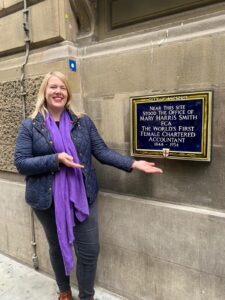
Julia Root-Gutteridge, who ran the project to mark 100 years of women in chartered accountancy, with the blue plaque which was only the third of 182 in the City of London to commemorate a woman
Position in professional history
ICAEW and later historians now place Mary Harris Smith at the start of a recognised lineage:
- She is listed as no. 1 among the “first ten female Fellows” of ICAEW.
- Subsequent pioneering women—such as Ethel Watts, the first woman to qualify via ICAEW examination (1924), and others—are framed as following the path she opened.
- Scholarly work on “professions and patriarchy” uses her decades-long campaign as a case study of how professional bodies used credentialism and charter language to maintain male monopolies, and how persistent individual and collective pressure eventually broke that barrier.
Her legacy in modern professional narratives is threefold:
- Proof of competence – She demonstrated over decades that women could not only perform but lead in complex financial and audit work.
- Challenge to institutional exclusion – Her repeated applications exposed the contradiction between professional ideals of merit and the reality of gendered closure.
- Symbolic first – Her eventual admission at age 75 crystallised the impact of the Sex Disqualification (Removal) Act and became a rallying reference point for generations of women accountants worldwide.
Concise Biographical Timeline
| Year | Age | Event |
| 1844 | 0 | Born in Kingsland, London. |
| c. 1860 | ~16 | Studies mathematics at King’s College School; attends bookkeeping classes run by SPEW. |
| 1860s–1870s | 20s–30s | Works for mercantile firm in the City; later accountant to Royal School of Art Needlework; undertakes audits for various organisations. |
| 1887 | 42–43 | Opens her own practice as “M. Harris Smith, Accountant and Auditor.” Applies to SAA/SIAA; application blocked. |
| 1891 | 46–47 | Applies to ICAEW as a fellow; recommended by committee but rejected on legal advice that only males are eligible. |
| 1895 | 50–51 | Publicly states: “Require of me what you would require of a man and I will fulfil it.” |
| 1896 | 51–52 | Request to sit ICAEW exams refused. |
| 1919 | 74–75 | Sex Disqualification (Removal) Act passed. Becomes Honorary Fellow of the Society of Incorporated Accountants and Auditors (admission dated 12 Nov 1919). |
| 1920 | 75–76 | Admitted as Fellow of ICAEW; recognised as world’s first female Chartered Accountant. |
| 1923 | ~78 | Acts as employer for Eslie Margaret Charlesworth, one of the earliest female articled clerks. |
| Late 1920s | 80s | Retires due to ill health. |
| 1934 | 89–90 | Dies in St Leonards-on-Sea, East Sussex. |
| 2020 | – | Blue plaque unveiled at Bucklersbury/Queen Victoria Street, City of London, marking her office and status as first female Chartered Accountant. |