Ordnance Survey Benchmarks in London and Their Uses

Discover the Hidden Marks in the City’s Stonework

If you’ve ever caught sight of a curious carved line with an arrow on the side of a building in London and felt a flicker of recognition, you’re already part of a rather small, rather special club. Most people hurry past without a second glance. But if you’re reading this, chances are you’re the sort who notices the quiet details the city keeps tucked away in its stone and brick.


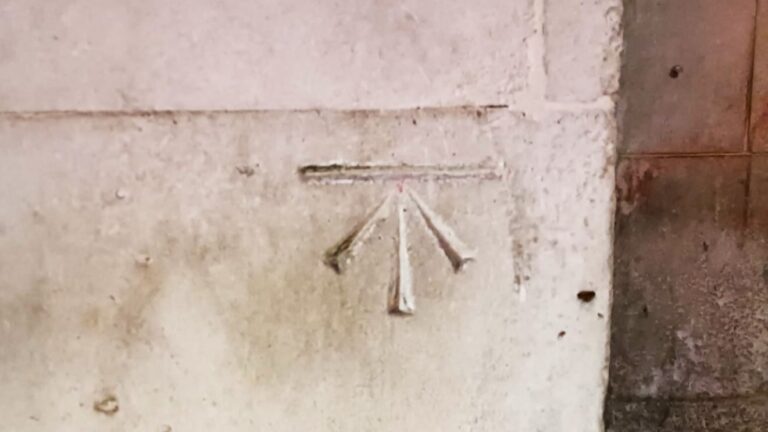
Those understated markings are not random graffiti or forgotten builders’ symbols. They are Ordnance Survey Benchmarks – relics from a time when the very height of Britain was being carefully, painstakingly measured. Once you know how to spot them, London’s streets begin to reveal a hidden layer of cartographic history that has been under our noses all along.

Benchmark in the City of London | London Guided Walks | Photo by Maria Alexe

What Are Ordnance Survey Benchmarks?

Ordnance Survey Benchmarks are small horizontal cuts in stone, usually paired with a distinctive arrow-like “broad arrow” carved beneath. They were deliberately placed on solid, long-lasting structures such as churches, public buildings and boundary walls – anything unlikely to shift or be demolished in a hurry.


These marks served as fixed reference points from which surveyors could measure height above mean sea level. Using a metal fitting and a measuring staff, they employed a technique known as spirit levelling to calculate precise elevations, quietly building up the data that underpins Britain’s detailed maps. In other words, these modest little cuts helped shape the way the country has been mapped and navigated for generations.

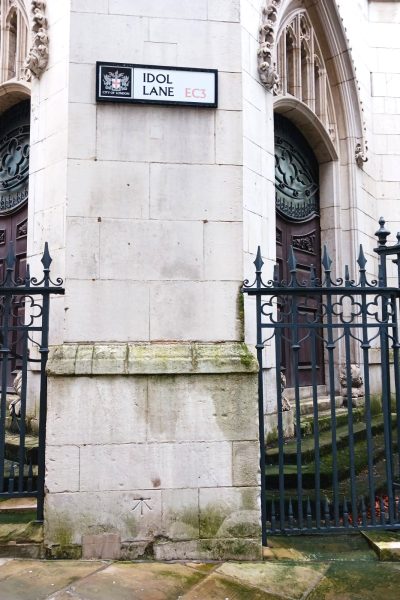
benchmark on Idol Lane
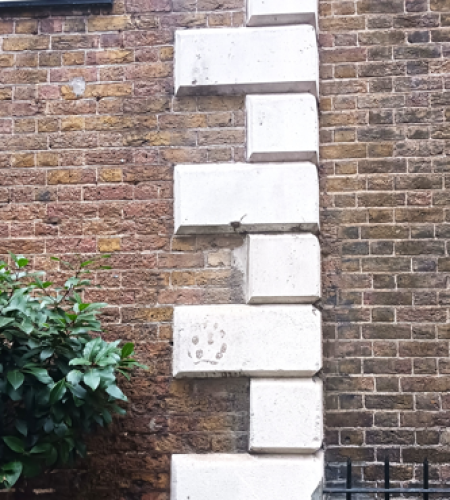
Benchmark on Lovat Lane | London Guided Walks | Photo by Maria Alexe

A Brief History Carved in Stone

The story of benchmarks begins in the early nineteenth century, when the Ordnance Survey – originally focused on military needs – turned its attention to recording height across Great Britain. Systematic work began around 1831 and accelerated after the Ordnance Survey Act of 1841, which gave legal backing to a national survey.

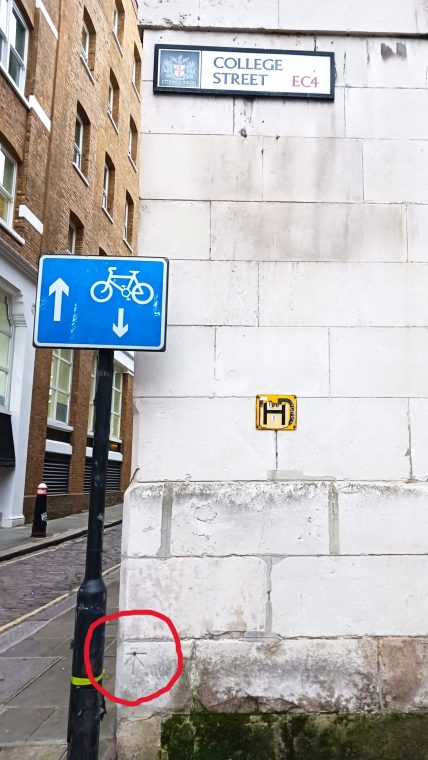
benchmark on College Street
Benchmark on College Street | London Guided Walks| Photo by Maria Alexe

Between 1831 and 1993, benchmarks were installed across the country, including thousands in London. They were placed on churches, town halls, railway bridges and other robust structures chosen for their stability, so that measurements would remain reliable over time. Although many have vanished through war damage, redevelopment or simple weathering, a surprising number survive in situ, quietly enduring as the city around them changes. The last traditional benchmark in the network is recorded as having been installed in Loughton, Essex, in 1993.

Where to Find Them in London

London is a particularly rewarding place to go benchmark hunting, especially if you enjoy historic corners and older streets. The City of London, with its parish churches and layers of rebuilding, is especially rich in surviving examples.


You’re most likely to find Ordnance Survey Benchmarks on:

  • Old parish churches, especially around doorways or buttresses
  • Historic civic buildings and former municipal offices
  • Sturdy boundary walls and institutional buildings

Georgian and Victorian façades in long-established streetsThey are often cut low down, close to ground level, which means they can be half-hidden by railings, traffic, or even modern signage. Once you’ve tuned your eye to that combination of a neat horizontal line and the subtle arrow beneath, you may find that streets you thought you knew suddenly feel different.

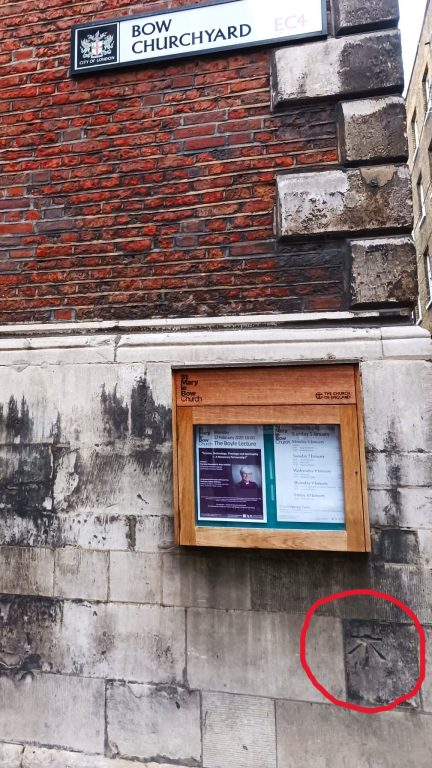
benchmark on St Mary le Bow
Benchmark on St Mary le Bow | London Guided Walks | Photo by Maria Alexe

Other Survey Marks to Watch For

Benchmarks belong to a wider family of survey marks that tell the story of how Britain was measured and mapped. If your curiosity is properly piqued, you might also spot:


  • Trig pillars: concrete pillars, usually on high ground, used for triangulation
  • Flush brackets: metal plates fixed to walls, each with its own reference number
  • Rivet benchmarks: small metal rivets set into stone or concrete, often in pavements or steps

Each of these marks contributed to a mesh of reference points that allowed surveyors to fix both position and height with increasing accuracy. Seen together, they form a kind of secret infrastructure – one that most people never notice, but which has shaped the way we experience maps and landscapes.

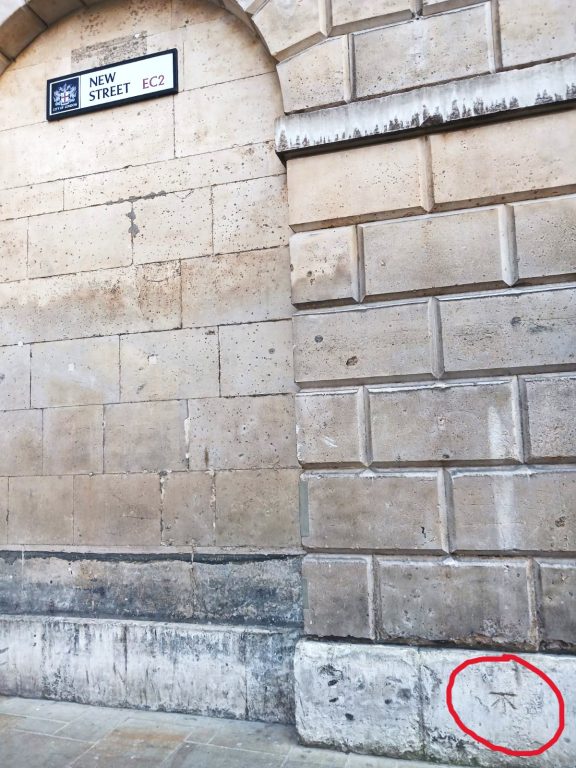
benchmark on New Street
Benchmark on New Street | London Guided Walks | Photo by Maria Alexe

Turning a Walk into a Treasure Hunt

One of the great pleasures of benchmark spotting is how it transforms an ordinary walk into something quietly adventurous. You find yourself slowing down, scanning doorways, church steps and corners of old walls for that tell-tale cut in the stone. It feels a little like a treasure hunt – except the “treasure” is a sudden awareness that the city is layered with stories and systems we rarely think about.


Once you start, it can be hard to stop. A familiar route to work becomes a potential survey trail. A lunchtime wander through the City turns into a small expedition in search of arrows carved over a century ago. There’s a particular satisfaction in finding one that thousands of people have walked past without ever seeing.

benchmark on Idol Lane
Benchmark on Idol Lane | London Guided Walks | Photo by Maria Alexe

Explore with a Guide Who Notices the Details

If this has stirred your curiosity, you might enjoy exploring these marks – and the wider stories of London’s streets – in person. As a qualified guide with London Guided Walks, Maria Alexe specialises in drawing attention to the details that usually slip by unnoticed: benchmarks on church walls, traces of former street levels, scars of past building lines and the quiet clues hidden in stone and brick.


On a private walking tour with Maria, you’ll wander through historic churches, alleyways and courtyards, discovering not just where benchmarks are, but what they tell us about how London has been measured, rebuilt and reimagined over time. Each walk is tailored to your interests, whether you’re drawn to surveying history, architectural detail or simply the joy of uncovering what others miss.

Facebook
Twitter
LinkedIn

Related Posts

Scroll to Top