Where is the new London Museum?
The new London Museum occupies Smithfield’s General Market in the City of London. The project has taken ten years and represents a £437 million investment, developed through a partnership between London Museum, the City of London Corporation and the Mayor of London, with philanthropic support.
It isn’t every day that a major national museum opens its doors, and this monumental project is expecting to welcome over 2 million visitors each year.
But this is not simply a new building filled with old things. The museum has brought a historic market back into public use after more than three decades. Its architecture is part of the experience, connecting the stories in the galleries with the working life of Smithfield itself.
The history of Smithfield’s General Market
The General Market opened in 1883 and was designed by Sir Horace Jones, the Victorian architect behind Leadenhall Market and Tower Bridge. After more than a century of trading, it closed in the 1990s and fell into disrepair.
Its transformation has been led by Stanton Williams, working with Asif Khan Studio and conservation architects Julian Harrap. Rather than removing every trace of the market, the restoration retains features that reveal its earlier life. Look out for original market signs, decorative ironwork, the wrought-iron Phoenix columns supporting the ceiling and the wonderfully curious “floating fireplaces”.
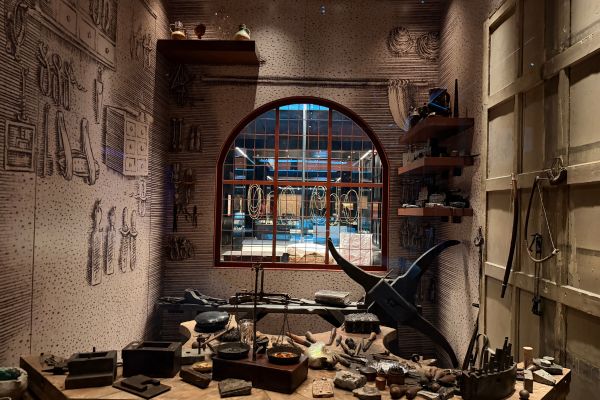
The work has involved expertise from more than 70 trades, including heritage coppersmiths, stonemasons and blacksmiths. It is a reminder that preserving London’s history depends on living skills as well as historic objects.
What is inside the new London Museum?
The museum unfolds across three main spaces: Real Time, Our Time, and Past Time. Together, they connect the London happening outside the doors with the lives of people who inhabited the city centuries ago.
Real Time: London as it happens
The entrance occupies a covered former street, West Poultry Avenue. Here, animated screens draw on contemporary data to reflect the city’s changing moods, listening habits and even its populations of pubs and bees.
There is history underfoot, too. Pottery fragments and discarded Victorian clay pipes are embedded in the floor, bringing traces of everyday London life into the entrance itself.
Other highlights include Banksy’s Piranhas sentry box, from his 2024 animal series, and a clock tower containing the final bell cast at the Whitechapel Bell Foundry. The bell will ring the museum open each day: a fitting new job for a piece of London’s manufacturing history.
Our Time: the places and things that bring Londoners together
Our Time occupies the former trading floor in the Linbury Hall. Its 13 large anchor installations explore how Londoners gather, socialise and share the city.
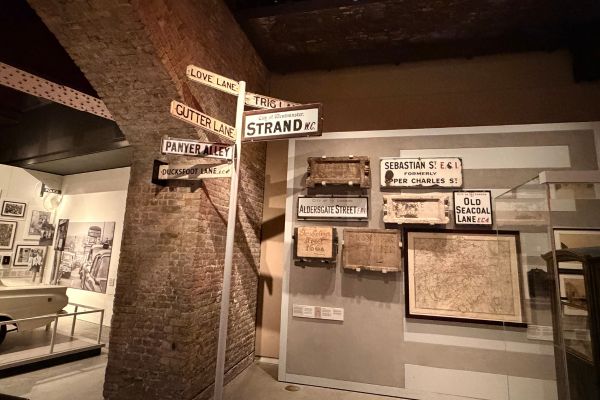
Among the objects are the Lord Mayor’s State Coach, dating from 1757, and the Buckingham Palace switchboard, decommissioned in 1970 and now displayed for the first time. Nearby, signs from places including Fabric nightclub, Topshop, the Galtymore Dance Club and the original Morley’s chicken shop in Sydenham, celebrate familiar meeting places.
Then there is Syd’s Coffee Stall, the century-old East End institution. Its role as a gathering place continues: the museum says it will offer free hot brews every Tuesday, supported by Rare Tea. That is a rather lovely way to keep an object’s social history alive.
Past Time: London history at Roman street level
Below ground, Past Time sits at Roman street level. The permanent gallery explores 2,000 years of London’s urban history, while also introducing the prehistoric people who lived beside the Thames before the Roman city developed.
The displays combine a chronological journey with themes such as work, worship, entertainment and the changing cityscape. Roman writing tablets, plague-era Bills of Mortality, suffragette material and objects from the London 2012 Olympic and Paralympic Games reveal very different experiences of London life.
Seven things to look out for at London Museum
1. The Cheapside Hoard
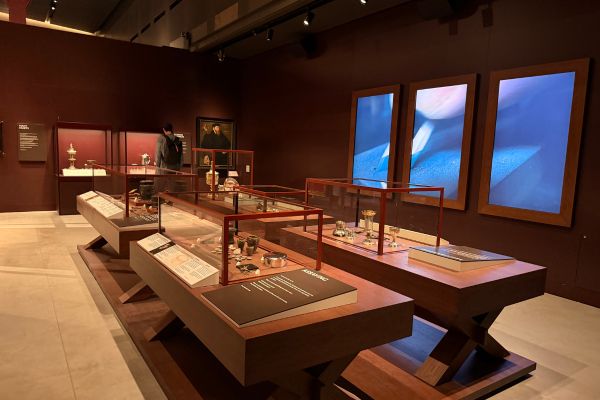
One of the museum’s great treasures, the Cheapside Hoard is an exceptional surviving collection of Elizabethan and Jacobean jewellery. It brings a dazzling contrast to the more everyday objects displayed elsewhere in the galleries.
2. A Roman wall painting rebuilt over 400 hours
Excavated in 2007, this 2,000-year-old wall painting has been painstakingly conserved and reassembled over 400 hours. It offers a glimpse of Roman London beyond roads, walls and military history: a city where people also decorated the spaces they occupied.
3. The Whitechapel Fatberg
Not everything worth preserving is beautiful. A chunk of the Whitechapel Fatberg takes its place in the galleries, bringing the story of London’s sewers—and what Londoners put into them—into the museum.
4. Emmeline Pankhurst’s hunger strike medal
The Votes for Women focus gallery draws on the museum’s extensive collection of militant suffragette material. Emmeline Pankhurst’s hunger strike medal is among the objects connecting individual experience with the wider struggle for political rights.
5. The bass guitar from London Calling
On loan from The Clash’s Paul Simonon is the smashed Fender Precision Bass immortalised on the cover of the band’s 1979 album London Calling. Other cultural highlights include Anna Pavlova’s Dying Swan costume, Charles Dickens’ chair and tablas belonging to British Bhangra pioneer Kuljit Bhamra.
6. A vest reputedly worn by Charles I
The museum displays a fine silk vest reputedly worn by King Charles I at his execution on the scaffold at Whitehall in 1649. Legend says he requested two shirts that freezing January morning so he wouldn’t shiver and make the crowd think he was afraid. While the vest bears dark stains once rumored to be royal blood, modern analysis suggests they are actually rust marks from storage. The word “reputedly” remains vital; the legend of the cold morning bravado is unforgettable, even if the precise provenance of the garment continues to spark debate among historians.
7. Real trains passing the galleries
A six-metre viewing window looks onto Thameslink trains travelling between Farringdon and City Thameslink. While visitors explore the history of London’s streets, sewers and railways, the modern transport network continues moving beyond the glass.
It is an unusually direct connection between a museum and the city outside.
Is the new London Museum suitable for families?
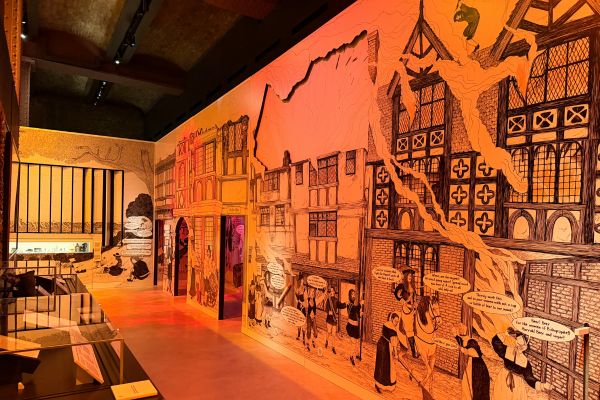
The museum includes family-focused displays and activities throughout its galleries. Visitors can eavesdrop on everyday dramas in a Roman shop, explore the Great Fire through a giant interactive graphic novel and follow an animal trail.
Storytelling begins in the N. Sethia Showspace from November 2026. Weekly family experiences developed with Punchdrunk Enrichment are scheduled to follow from January 2027. Not all activities therefore begin on opening day.
Food, drink and late openings
Food is part of the museum’s story, not simply a break from the galleries. Its first season, London Tastes, runs from November 2026 to August 2027, with guest editors Ruby Tandoh and Jonathan Nunn exploring the capital’s changing appetites. Subjects range from pie and mash and chicken shops to markets, manufacturers and neighbourhood food cultures.
Places to eat and drink include Clerk’s House, Bartholomew’s bar and the alcohol-free Temperance Cocoa Rooms. A further space, The Roost, is due to open in early 2027.
Friday and Saturday opening hours extend to 11pm. The museum’s programmed late-night events, supported by Morley’s and featuring a resident DJ collective, begin from December 2026.
New London Museum: key visitor information
What opens in 2027 and 2028?
The November opening is a major milestone, but it is not the end of the project.
In spring 2027, an 800-square-metre network of underground vaults will open to visitors. Rediscovered during construction in 2019, these spaces will host the free exhibition Londinium: the making of a Roman city, drawing on the Bloomberg Collection to explore Roman London’s turbulent first 50 years.
The adjacent Poultry Market is scheduled to open in 2028, providing two temporary exhibition spaces, a dedicated learning centre and a collection store.
Why this museum tells more than one London story
More than 100,000 people helped shape this vibrant new space, from local schoolchildren and silversmiths to artists and writers. Its displays place royal objects side by side with iconic street signs, protest banners, sporting kits and the tools of everyday working life, serving as a living cultural collection that constantly challenges what it truly means to be a Londoner today.
That breadth is what makes the prospect so appealing. London’s history is not only the story of who governed it or which buildings survived. It is also the story of where people met, what they made, what they fought for and how they found their place in a constantly changing city.
The new London Museum opens its free permanent galleries at Smithfield on Saturday 28 November 2026. Take it from a local tour guide – come for the famous treasures, but make sure to marvel at the magnificent market building and leave plenty of time for the quirky, everyday objects. They have the most authentic London stories to tell!
Frequently asked questions about the new London Museum
When does the new London Museum open?
The new London Museum opens to the public on Saturday 28 November 2026. This opening covers the free permanent galleries in Smithfield’s General Market. An exhibition in the underground vaults follows in spring 2027, with the adjacent Poultry Market scheduled to open in 2028.
Where is the new London Museum?
The new London Museum is in the historic General Market at Smithfield, in the City of London. The Victorian market building opened in 1883 and has been restored to house the museum’s galleries and public spaces.
Is the new London Museum free to visit?
Yes, the new London Museum’s permanent galleries are free to visit. The museum has also announced that its first exhibition in the underground vaults, Londinium: the making of a Roman city, will be free when it opens in spring 2027.
What are the new London Museum’s opening hours?
London Museum’s announced opening hours are 10am–6pm from Sunday to Thursday and 10am–11pm on Fridays and Saturdays. For Friday and Saturday evenings, last ticketed entry is 7.15pm, with walk-ins subject to availability until 9.30pm.
What can you see at the new London Museum?
Highlights include the Cheapside Hoard, the Lord Mayor’s State Coach, the Buckingham Palace switchboard, Syd’s Coffee Stall and a piece of the Whitechapel Fatberg. The galleries also display Roman objects, suffragette material, Anna Pavlova’s Dying Swan costume and Tom Daley’s London 2012 Olympic diving trunks.
Can you see real trains from inside London Museum?
Yes. A six-metre viewing window in the underground Past Time gallery overlooks passing Thameslink trains travelling between Farringdon and City Thameslink. Visitors can watch the working railway while exploring displays about London’s history and changing urban landscape.
Is the new London Museum suitable for children?
Yes. Family features include an animal trail, a Roman shop experience and a giant interactive graphic novel exploring the Great Fire of London. Storytelling starts in November 2026, with additional weekly family experiences created with Punchdrunk Enrichment scheduled from January 2027.