Introduction
In the 1540s, Henry VIII dramatically expanded England’s coin production by establishing six new mints to supplement the existing Royal Mint at the Tower of London. Three of these were located in London—at the Tower, Durham House on the Strand, and Southwark—while others operated in Canterbury, York, and Bristol.
The Southwark mint was based at Suffolk Place, the former manor house of Charles Brandon, Duke of Suffolk and brother-in-law to Henry VIII. Today, this historic site is remembered in the names Mint Street and Mint Street Park.
Why Henry VIII Built the Southwark Mint
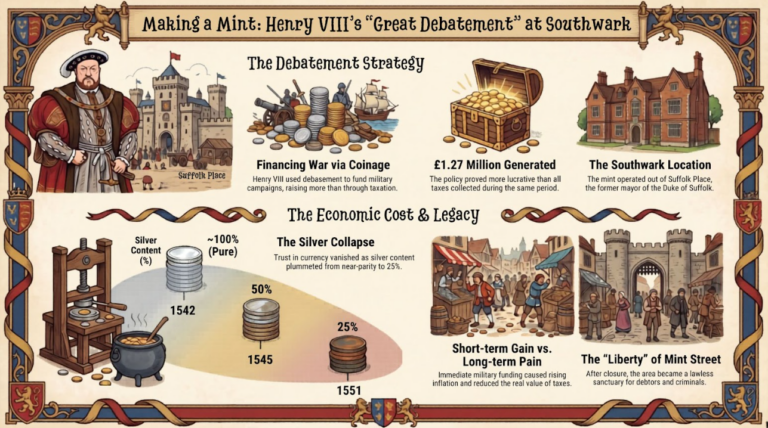
Henry VIII’s decision to open new mints was driven by an urgent need for money. Alongside taxation and the Dissolution of the Monasteries, he financed costly military campaigns through the debasement of the coinage—reducing the precious metal content of coins while maintaining their face value.
Although debasement offered a quick financial boost, it came with serious consequences:
- Rising inflation as prices adjusted to lower-quality coinage
- Loss of public confidence in English currency
- Reduced real value of tax income, since taxes were paid in coin
Despite these risks, the policy proved lucrative. Historian C.E. Challis estimates Henry raised around £1.27 million through debasement—more than he generated through taxation during the same period.
How Tudor Coin Debasement Worked
The process began with raising the “mint price”—the rate paid by mints for bullion. This attracted:
- Silver from dissolved monasteries
- Existing coins brought in for reminting
- Raw bullion
These materials were melted down and reissued as new coins. Over time, the silver content dropped dramatically:
- 1542: Nearly pure silver
- Early debasement: 75% silver
- 1545: 50% silver
- 1551: Just 25% silver
As the silver content fell, so did trust in the currency. Eventually, the financial benefits of debasement declined, while inflation and economic disruption increased.
The Closure of the Southwark Mint
By 1551, the Great Debasement had reached its limits. The government began restoring coinage to higher standards, and the extra mints—no longer necessary—were closed. The Southwark mint shut the same year.
The site was later granted by Queen Mary I to Nicholas Heath, Archbishop of York. In 1557, Suffolk Place was demolished and replaced with smaller properties, reshaping the area’s landscape.
Southwark Mint and the Liberty of Mint Street
Even after the mint closed, its legacy shaped Southwark’s social history. The area became a “liberty,” meaning it lay outside normal legal jurisdiction. As a result, it developed a reputation as a sanctuary for:
- Debtors
- Criminals avoiding arrest
- Marginalised communities
This reputation endured for centuries, making Mint Street one of London’s most intriguing historical locations.
Explore Southwark’s Hidden History
Discover the stories behind Mint Street, Tudor coinage, and Southwark’s lawless past on a guided walk.
Book your place on a Southwark walking tour or arrange a private Southwark tour to explore this fascinating area with an expert guide.