
Five Cathedrals, Fires and Destruction: The History of St Paul’s Cathedral

Introduction

Did you know that as many as five cathedrals have stood on the single site where St Paul’s Cathedral stands today? The long and dramatic history of this iconic London landmark is filled with destruction, resilience, and rebirth.

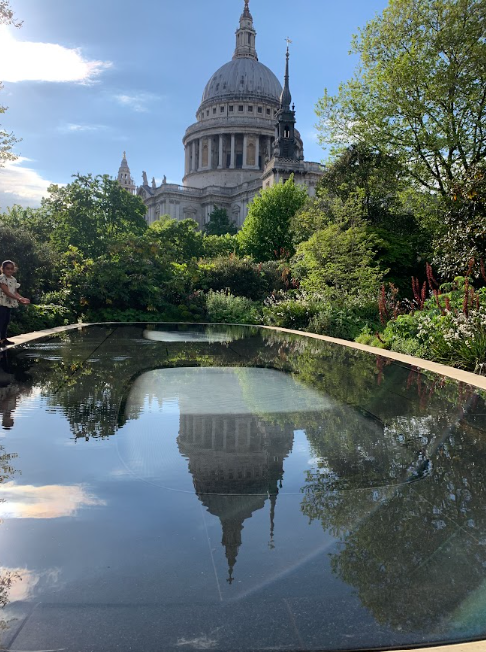
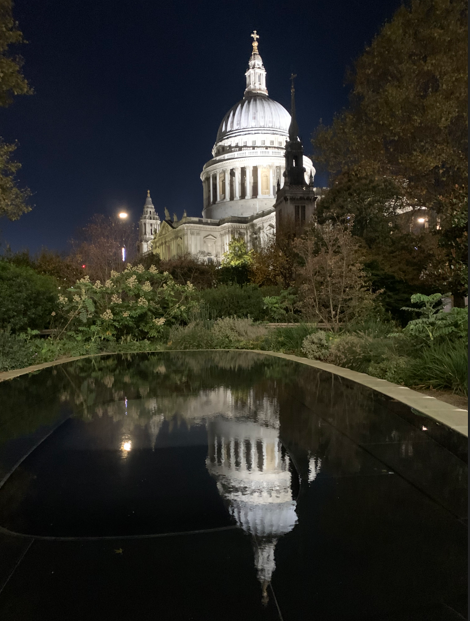
The reflection pool at Cannon Street | London Guided walks | Photo by Jenny Funnell

The Early Cathedrals: Vikings, Saints, and Fire (604 AD – 961 AD)

The site’s royal and religious history began in 604 AD, when Pope Gregory sent Mellitus to convert King Saebert to Christianity. Consecrated as the first Bishop of London, Mellitus had a cathedral built for him, though sadly no records or descriptions remain of its structure.

In 675 AD, a second cathedral was erected for Erkenwald, who was later canonised as a saint. His shrine at St Paul’s became a major pilgrimage site for centuries. Tragic fate struck in 961 AD when Viking raiders burned the cathedral to the ground; yet miraculously, St Erkenwald’s shrine survived intact and was preserved within the third cathedral built on the site.

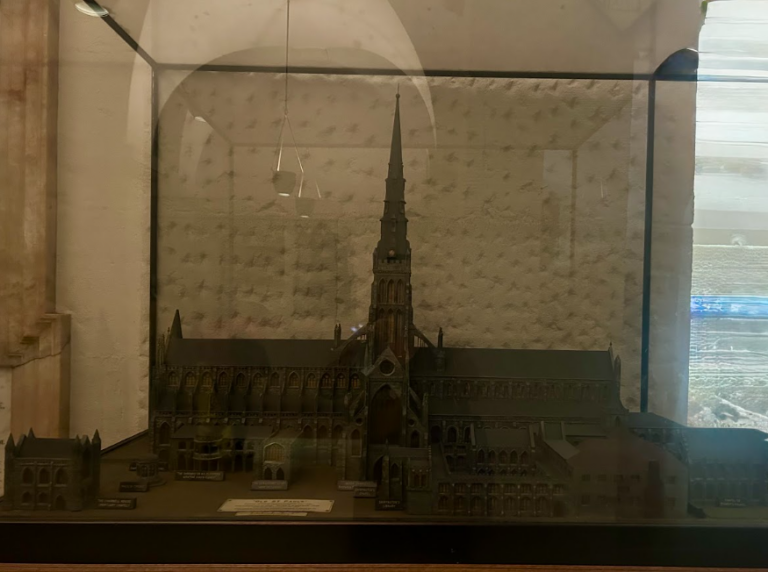
Model of Old St Paul’s | London Guided Walks | Photo by Jenny Funnell

Old St Paul’s: Norman Splendour, 'Paul’s Walk', and Desecration

Fire remained a constant threat throughout the history of St Paul’s. Rebuilding commenced in 1087 under Bishop Maurice following the Norman Conquest. Stone was transported across the English Channel from Caen, Normandy. Taking over two centuries to finish, it was consecrated in 1240.

Old St Paul’s wall tile in Vintry passage | London Guided Walks | Photo by Jenny Funnell

This magnificent cathedral boasted a soaring spire reaching roughly 489 feet, completely dominating the London skyline from Ludgate Hill for nearly 600 years. However, in June 1561, a lightning strike ignited and destroyed the spire. For over a century, St Paul’s remained with only a stubby tower where the grand spire once stood.

Old St Paul’s after the Spire had burnt down. Wikipedia | Photo by Wenceslaus Hollar, Public domain, via Wikimedia Commons

During this era, the nave was far from the serene place of worship seen today. Known as ‘Paul’s Walk’, the central aisle became a bustling public square where Londoners flaunted fashions, traded news, and transacted business. These visitors were known as ‘Paul’s-walkers’ and ‘news-mongers’ long before newspapers existed. Unfortunately, ‘Paul’s Walk’ also attracted pickpockets (‘cut-purses’), thieves, and prostitutes.

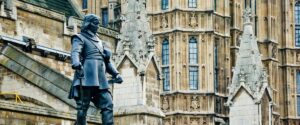
Further desecration occurred during the Commonwealth under Oliver Cromwell and the Puritans. Viewing the cathedral as a symbol of royal power and Anglican excess, Cromwell’s New Model Army converted the vast nave into a stable for up to 800 horses. Stained glass windows were smashed, and wooden pews were ripped out to serve as firewood.

The Restoration and the Great Fire of 1666

Following the Restoration of the Monarchy in 1660 under Charles II, St Paul’s Cathedral was in a state of severe decay. Architect Inigo Jones’s classical western portico was badly damaged. When King Charles II commissioned Sir Christopher Wren to repair the structure, Wren advised pulling it down completely. The King refused on cost grounds, ordering Wren to erect wooden scaffolding and rebuild the spire.

Then came the catastrophic night of 1st–2nd September 1666. Baker Thomas Farrinor failed to properly extinguish his oven in Pudding Lane. Combined with a hot, dry summer, a Thames drought, and strong easterly winds, a terrifying firestorm swept through London. Over four days, the blaze destroyed 13,200 houses, 87 city churches, 52 Livery Company Halls, and the Royal Exchange.

Londoners believed the massive stone structure of St Paul’s would withstand the fire. However, wind-blown embers ignited the wooden scaffolding. The cathedral was consumed in a 1,700°C inferno. Lead roofs melted like snow, and stone vaulting collapsed. Diarist Samuel Pepys described the scene as a “horrid malicious bloody flame,” while Sir John Evelyn lamented, “London was, but is no more!”

Resurgam: Rising from the Ashes

Despite the devastation, London was painstakingly rebuilt by Sir Christopher Wren, alongside Dr Robert Hooke, Nicholas Hawksmoor, master stonemasons Thomas Strong and Edward Marshall, and woodcarver Grinling Gibbons.

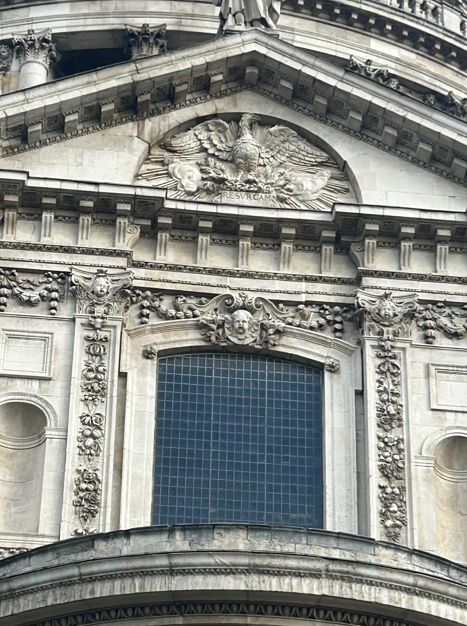
On the southern pediment of St Paul’s sits a carved phoenix accompanied by the word ‘RESURGAM’ (‘I shall rise again’). During the rebuilding, stone carver Thomas Strong handed Wren a piece of broken tombstone from the rubble to mark the initial building line. The fragment bore the single word ‘Resurgam’. Taking this as a symbol of hope for London, Wren commissioned sculptor Caius Gabriel Cibber to carve the phoenix above the legend—a permanent reminder that, like the mythical bird, St Paul’s and the City of London rose triumphantly from the ashes.

Resurgam on the southern transept | London Guided Walks | Photo by Jenny Funnell

Call to Action

Want to discover more fascinating London history? Book either a City Highlights Private tour or a Great Fire of London Tour with Jenny Funnell

Facebook
Twitter
LinkedIn

Related Posts

Scroll to Top