Introduction
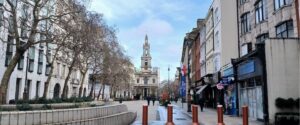
There are buildings in the City of London that you walk past every day without a second glance and then there are those that, once you step inside, completely rewrite your understanding of a place. Chartered Accountants’ Hall, known today as One Moorgate Place, is firmly in the second category: a Grade II* listed masterpiece and the headquarters of ICAEW (he Institute of Chartered Accountants in England and Wales)since the 1890s. Our recent private visit, led by Peter O’Reilly, revealed a building where every ceiling, staircase and window tells a story.
Why We Were There
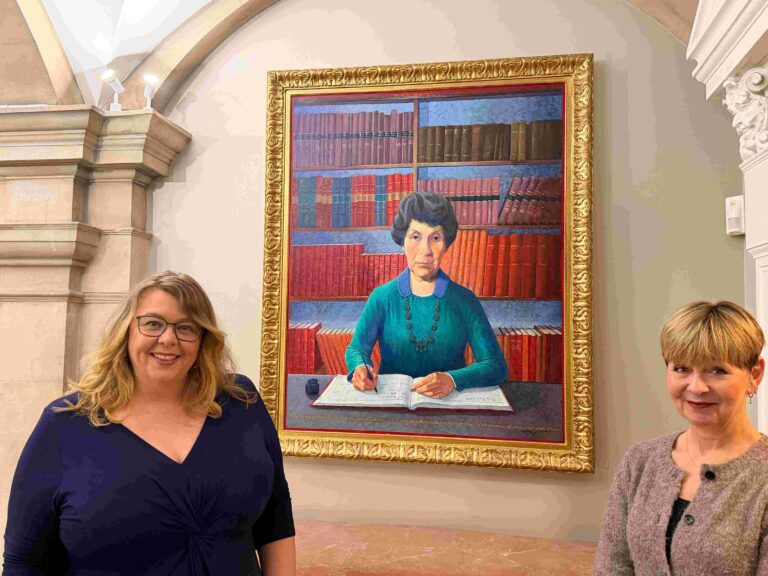
Jenny and I have been researching the remarkable story of Mary Harris Smith – the world’s first female Chartered Accountant – for some time. Jenny recently joined me on the London History Podcast to explore Smith’s life, so visiting ICAEW’s home felt like a natural next step: this is the institution that once rejected Smith, and later became the body that finally recognised her. The highlight of our visit was seeing the newly commissioned portrait of Mary Harris Smith by award‑winning Dorset artist Toby Wiggins, now hanging proudly inside the building.
Who Was Mary Harris Smith?
Born in Kingsland, London, in 1844, Mary Harris Smith grew up in a family connected with banking and naval agency work, which helped nurture her gift for numbers from an early age. She studied at King’s College School at sixteen and later enrolled on bookkeeping courses run by the Society for Promoting the Employment of Women, one of the earliest organisations to provide structured commercial training for women.
In 1887 she opened her own accountancy practice in London, trading as “M. Harris Smith, Accountant and Auditor,” and built up a client list that included women’s organisations and charitable bodies as well as commercial firms. When she applied to join ICAEW in 1891, Council refused her on the grounds that their charter referred to “men” and that admitting a woman would set an unacceptable precedent. The then president, Charles Fitch Kemp, openly stated that he would rather resign than see women admitted – a neat summary of the institutional barriers she faced.
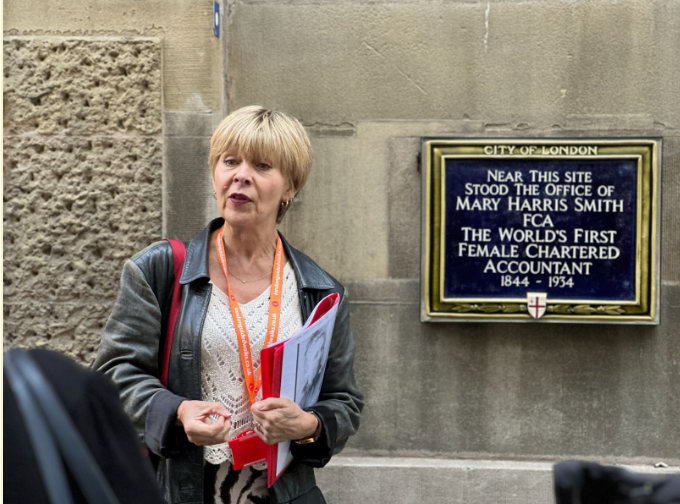
Smith did not back down. In 1895 she wrote that if the Institute would “require of me what you would require of a man I will fulfil it,” capturing both her professional confidence and her frustration. Only after the Sex Disqualification (Removal) Act 1919 made it illegal to exclude women from professions on the basis of sex did ICAEW finally admit her, and in May 1920, aged seventy‑five, she became the first female Chartered Accountant in the world. Today she is commemorated with a City of London blue plaque near her former office, and now with a portrait inside Chartered Accountants’ Hall itself.
The Portrait by Toby Wiggins
To mark the centenary of Smith’s admission, ICAEW commissioned a new portrait from Toby Wiggins, a member of the Royal Society of Portrait Painters who trained at Bournemouth, Falmouth and the Royal Academy Schools. Wiggins is known for portraits that combine precise draughtsmanship with a quiet psychological intensity, often placing sitters in settings that hint at their inner lives.
In the portrait, Mary Harris Smith is seated at a desk, pen poised above an open ledger, against a backdrop of shelves lined with orderly volumes – a visual shorthand for a lifetime spent amid books, balance sheets and ledgers. Her expression is focused rather than decorative, inviting you to meet the eyes of a woman who spent decades being told “no” and ultimately transformed that into a resounding “yes.” For Jenny and me, standing there side by side, it felt particularly powerful to see a woman who worked in the City at a time when women could not even join the profession now holding pride of place in ICAEW’s headquarters.
John Belcher’s Architectural Vision
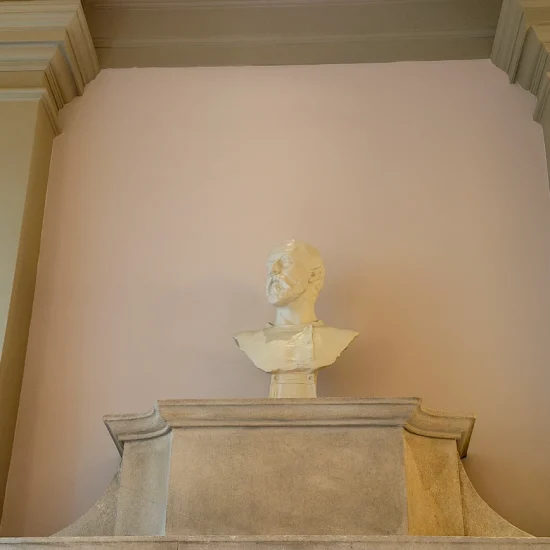
Chartered Accountants’ Hall was designed by architect John Belcher RA and completed in 1893, when ICAEW was still a relatively young professional body. Belcher was already an established figure in late Victorian architecture, noted for his inventive use of sculpture and his enthusiasm for continental precedents, especially the Italian Renaissance.
He had spent time travelling in Italy and living in Venice, and you can feel that influence throughout the building: the rich modelling of the stonework, the theatrical staircases, and the way sculptural friezes are integrated into the façade all recall grand civic palazzi rather than a sober office block. Architectural historian Nikolaus Pevsner described the Hall as “eminently original and delightfully picturesque,” praising the way Belcher merged architecture and sculpture into a unified whole.
Belcher was unusually hands‑on, famously saying that every detail was worked out by himself, and ICAEW’s archives show him still commenting on decorative decisions decades after the building opened. Outside, a long sculpted frieze by Harry Bates and Hamo Thornycroft wraps around the building, populated with allegorical figures representing Arts, Sciences, Crafts, Commerce, Agriculture, Shipping and more – a stone‑carved panorama of Victorian industry and imperial reach.
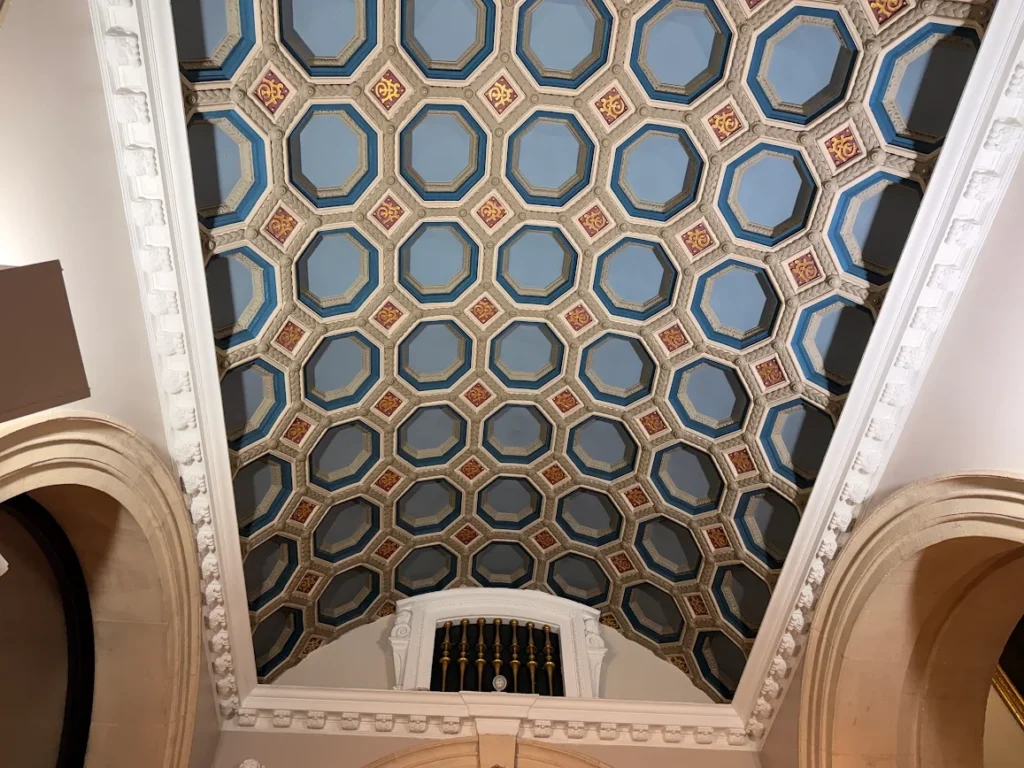
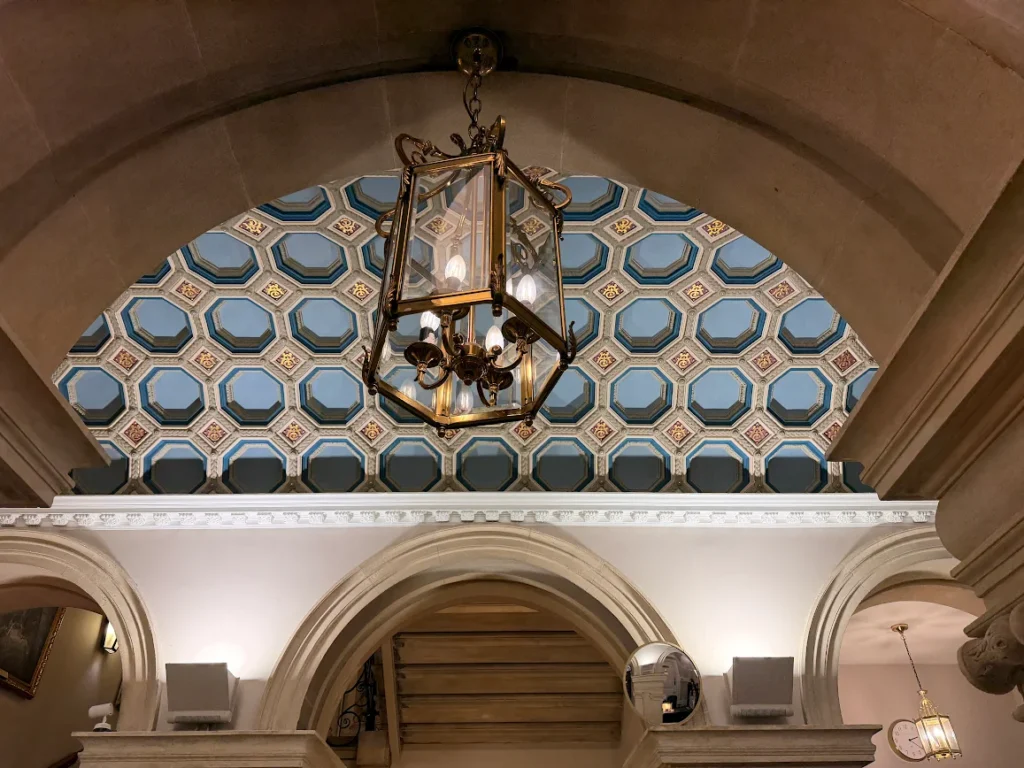
CAEW entrance hall ceiling with ICA in gold leaf | Photo by Hazel Baker
The Entrance Hall and Staircase
Our visit began in the entrance hall, where Belcher’s love of drama is immediately apparent. The floor is laid in bold black‑and‑white marble, creating a strong geometric pattern that draws you inward towards the staircase. Above, an ornate coffered ceiling – its pattern based on Alessi’s sixteenth‑century Palazzo Cambiaso in Genoa – rises over stone arches and columns, giving the space an almost ecclesiastical grandeur.
The twin staircases climbing from the entrance feel almost ceremonial, framing the view upwards and hinting at the riches beyond. Today this area also showcases interpretive panels and digital displays, but the underlying structure is very much Belcher’s: a confident statement that chartered accountancy, for all its ledgers and numbers, deserved a headquarters as impressive as any livery company hall in the City.
The Members’ Room and Its Indoor Rialto Bridge
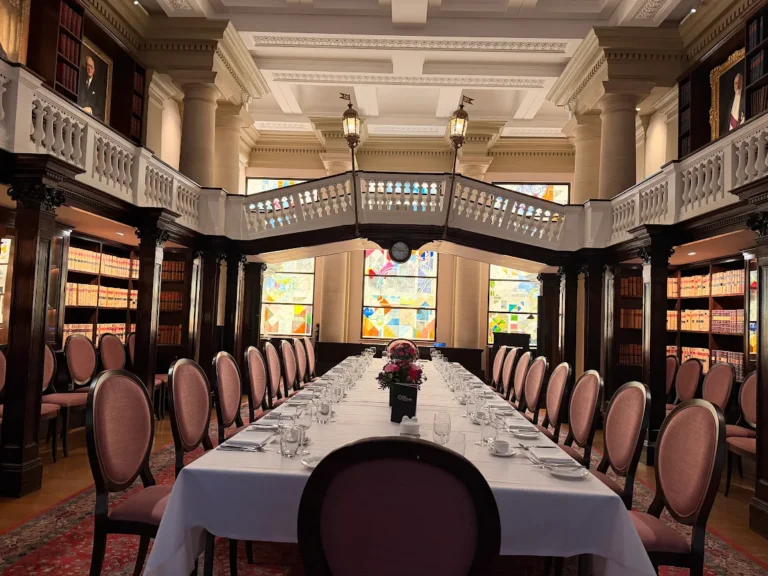
One of the great surprises of the tour was the Members’ Room, originally designed as the library. Here Belcher created what must surely be one of London’s most unusual interior features: an indoor bridge modelled on the Rialto Bridge in Venice, spanning the centre of the room. Thought to be one of the very few indoor bridges in the UK, it provides a dramatic vantage point from which to admire the room’s double‑height shelves and stained glass.
The room is lined with dark timber bookcases and framed by columns, with soft rugs underfoot and a long table set for dining – the effect is a cross between a Venetian reading room and a private club. It’s easy to imagine nineteenth‑century accountants debating professional standards here under the glow of gas or early electric light, surrounded by law reports and accounting manuals. Today members still use this as a social and working space, and it is often reconfigured for dinners and events, including the beautifully laid‑out setting we saw during our visit.
Alexander Beleschenko’s Contemporary Stained Glass
In August 2022 ICAEW unveiled three striking new stained glass windows in the Members’ Room by artist Alexander Beleschenko, known for large‑scale architectural glass commissions across the UK and Europe. Each window comprises more than 1,000 pieces of glass, individually painted and fired at around 600 degrees centigrade before being laminated into three layers and backlit with LEDs.
Beleschenko has explained that the subtle grid that runs through the design is inspired by the black‑and‑white floor pattern of the Moorgate entrance, while the bold coloured forms respond to the rhythm and colours of earlier stained glass elsewhere in the building. The result is a contemporary work that feels rooted in its surroundings: when you stand in the Members’ Room, you see Victorian dark wood, an Italianate bridge and thoroughly modern glass all holding a conversation across more than a century.
The Main Reception Room: George Murray’s Murals
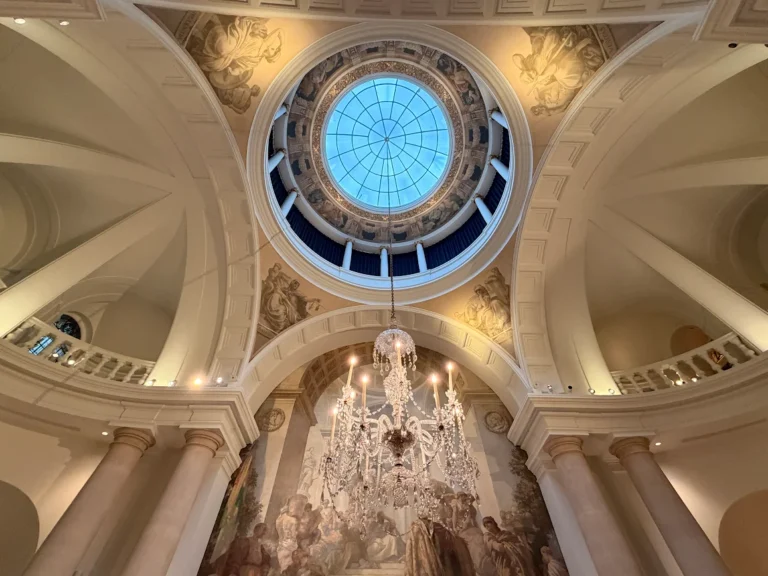
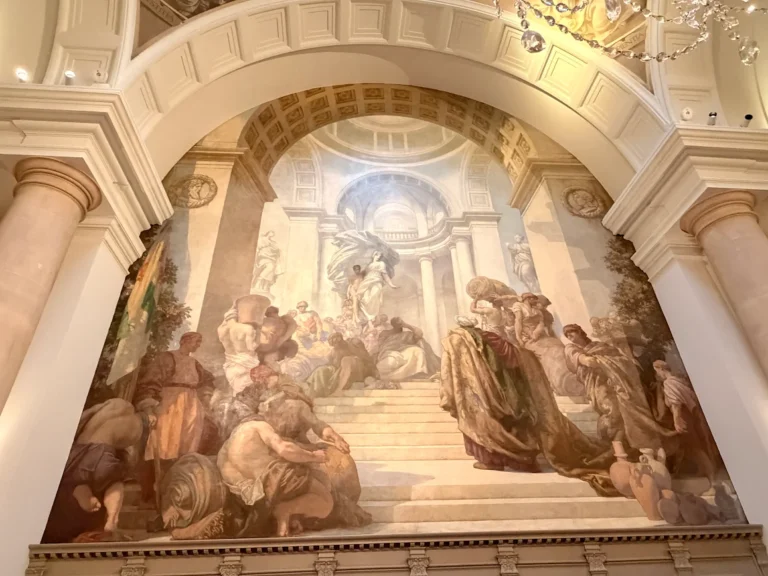
The former Council Chamber, now known as the Main Reception Room, might be the most jaw‑dropping space in the whole complex. It has a high domed ceiling of glass, ringed by columns and stained glass windows that flood the room with coloured light. On entering, the impression is almost that of a small chapel or civic rotunda – which makes sense when you remember that this is where the great decisions of the Institute were once debated.
Belcher had always intended that the walls would be decorated with murals and initially commissioned designs from Scottish artist M. Moudan Loudan, including a proposed scene from Shakespeare’s “Merchant of Venice,” but these were never executed. In the end he turned to artist George Murray, who between 1913 and 1914 created a cycle of vast allegorical paintings that take the entire room as their stage.
The murals are themed around “the Triumph of Law and Science bringing Order to Commerce.” In one scene, the figure of Justice is crowned, symbolising the primacy of law and ethical practice in commercial life. In another, Justice dramatically slays the figure of Anarchy with a flaming sword, a vivid reminder of Victorian anxieties about unregulated markets and moral disorder. Murray cleverly painted the architecture of the room itself into the background, producing a mirror‑like effect that visually enlarges the space and blurs the line between painted and real columns.
Look closely and you can see personifications of Wisdom, Truth, Prudence and Justice bearing shields with the arms of London, Liverpool, Sheffield and Manchester – the four cities whose local accountancy associations first came together to form ICAEW. In a single room, then, you have law, science, commerce, four major industrial cities and the professional identity of chartered accountants all woven together in paint.
Henry Holiday’s Stained Glass and the Led Zeppelin Connection
No visit to Chartered Accountants’ Hall would be complete without the story of the Henry Holiday windows. Holiday was a leading Victorian stained glass designer associated with the Pre‑Raphaelite circle and the firm of James Powell & Sons, known for compositions that combine strong architectural structure with calm, hieratic figures. In 1898 ICAEW commissioned him to design four large windows for the Hall, each exploring a different theme drawn from the profession: Law, Enterprise, Commerce and Finance.
Holiday initially struggled with the brief, but once he grasped the multidisciplinary nature of accountancy – cutting across legal, commercial and financial domains – he produced designs populated with allegorical figures embodying virtues such as Accuracy, Probity, Prudence and Knowledge. The result is a cycle of windows that elevate what might seem a dry subject into something almost theological: an ordered universe of numbers, ethics and trade rendered in glowing glass.
The windows were installed as part of ICAEW’s celebration of Queen Victoria’s Diamond Jubilee and remained in place until the late 1960s, when architect William Whitfield extended the building with a new tower and Great Hall. To make way for the changes, the Holiday windows were removed and eventually sold, ending up in the hands of Peter Grant, the famously formidable manager of rock band Led Zeppelin.
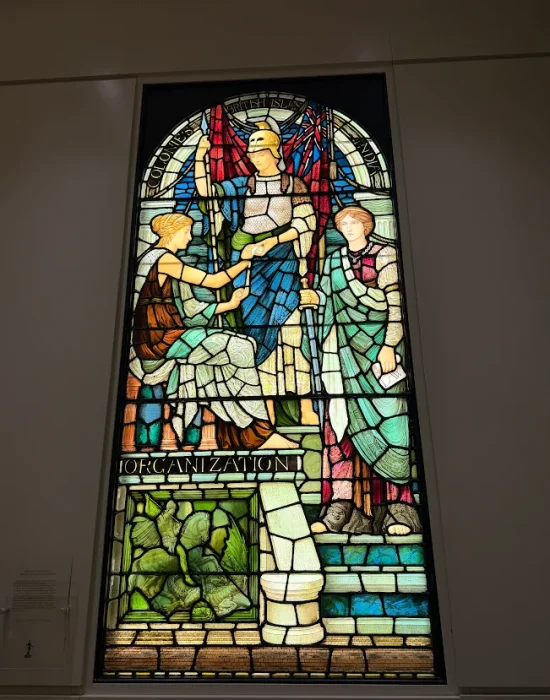
Grant stored the windows in a barn, where they lay forgotten for decades until after his death in 1995, when his family rediscovered them and put them up for auction. The ICAEW Foundation, whose role includes preserving the Institute’s heritage, recognised them and successfully bid to bring them home. In 2017 the four windows were reinstated at Chartered Accountants’ Hall, now displayed near the entrance to the Great Hall – a remarkable story of loss, rock‑and‑roll exile and eventual return, pulvinar dapibus leo.
Extensions, Modernism and Brutalism
As ICAEW’s membership grew, the Hall needed more space. The first major extension arrived in 1930–31, designed by John James Joass, Belcher’s former pupil and later partner. Joass continued Belcher’s neo‑Baroque language along Great Swan Alley, adding new offices, panelling and a lift in a style that blends so harmoniously with the original façade that it is hard to see where Belcher stops and Joass begins.
The second big transformation came in the 1960s, when architect Sir William Whitfield designed a starkly modern, Brutalist addition that includes the Great Hall and a tower rising above the older structures. Whitfield’s design used exposed concrete and crisp geometric forms, a deliberate contrast to the exuberant Victorian ornament below, and it received a Certificate of Commendation from The Concrete Society for its bold handling of the material. The only major casualty was the Oak Hall – formerly the Examination Hall – which Whitfield judged already compromised by earlier alterations and replaced with a new Council Chamber.
Seen together, Belcher’s original hall, Joass’s sympathetic extension and Whitfield’s Brutalist tower explain why Chartered Accountants’ Hall is now listed Grade II* and often cited as one of the most architecturally interesting professional headquarters in Britain.
For Jenny and me, this wasn’t just a tour of a beautiful building; it was a chance to see how bricks, stone, glass and paint have been used over 130 years to express the values of a profession – and to reflect on who was left out of that story. Mary Harris Smith once stood outside the institution that refused to recognise her; now her portrait hangs inside a hall ringed with allegories of Justice, Prudence and Knowledge. That shift, from exclusion to commemoration, is powerful.
Jenny’s Pioneering Women in the City walking tour picks up exactly these threads – the women who were overlooked, obstructed and eventually, sometimes grudgingly, welcomed. Seeing Smith’s portrait in situ at Chartered Accountants’ Hall adds an emotional punch that no archive document can match; it turns a story into a face across the room.
A heartfelt thank you to Ruth Pott‑Negrine for organising the visit and to Peter O’Reilly for such an insightful tour. If you have the opportunity to step inside One Moorgate Place – whether during the Open House Festival or on a specially arranged visit – seize it. Hidden behind that restrained City façade is a building that will change how you see both London’s architecture and the history of the professions.
Want to explore more stories of pioneering women in the City of London?