
The Proms is a classical music festival held every summer at the Royal Albert Hall in London. Its aim is to bring the best in classical music to the widest possible audience. Join Hazel Baker as she shares stories of how the proms began, where it gets its name, how politics has sometimes clashed with the event and how a stag was released from Door 1 at the Last Night of the Proms.

The Proms and The Royal Albert Hall
Recommended Reading:
Show Notes:
 Hazel Baker: Hello and welcome to London Guided Walks London History podcast. In the coming episodes, we will be sharing our love and passion for London, its people, places and history in an espresso shot with a splash of personality. For those of you who don’t know me, I am Hazel Baker, founder of London Guided Walks, providing guided walks and private tours to Londoners and visitors alike.
The Proms is a classical music festival held every summer at the Royal Albert Hall in London. Its aim is to bring the best in classical music to the widest possible audience.
The Proms was the brainchild of the impresario Robert Newman, manager of the newly built Queen’s Hall close to the BBC’s Broadcasting House. Newman had previously organised symphony orchestra concerts at the hall, his aim was to reach a wider audience by offering more popular programmes, adopting a less formal promenade arrangement, and keeping ticket prices low.
_______________________________
Why are They called the Proms?
‘Proms’ is short for Promenade concerts – informal and inexpensive concerts with an opportunity for Promenaders (‘Prommers’) to stand and listen.
The popular tradition of Promming (standing in the Arena or Gallery areas of the Royal Albert Hall) is central to the unique and informal atmosphere of the BBC Proms. At Shakespeare’s globe they are called groundlings.
Normally up to 1,350 standing places are available for each Proms concert at the Royal Albert Hall, although the capacity may vary for each Prom, and of course this year is the first year Promming won’t be available.
_____________________________
The first ever Proms
Newman wanted to expand upon his dream of making music more accessible and met English conductor Henry Wood at Queen’s Hall one spring morning in 1894. ‘I am going to run nightly concerts to train the public in easy stages,’ he explained. ‘Popular at first, gradually raising the standard until I have created a public for classical and modern music.’ In February 1895 Newman offered Wood conductorship of a permanent orchestra at Queen’s Hall.
The first Proms concert took place on 10 August 1895. Wood and Newman were keen to introduce audiences to an ever wider range of music. The informal atmosphere was encouraged by cheap promenade tickets – one shilling (5p) for a single concert, or a guinea (£1.05) for a season ticket. Eating, drinking and smoking were permissible.
________________________________
Growing from strength to strength
By 1920 Wood had introduced to the Proms many of the leading composers of the day, including Richard Strauss, Debussy, Rakhmaninov, Ravel and Vaughan Williams.
On 10 May 1941 a Luftwaffe bombardment gutted the Queen’s Hall. The only other hall available in London for orchestral concerts was the Royal Albert Hall, opened in 1871. The Proms took place there in 1941.
After the War, unsurprisingly, the traditional Wagner Nights which had been an original part of the programme were no longer fashionable. And so from 1953 Viennese evenings became the popular event and composer anniversaries were well catered for. The deaths of Sibelius and Vaughan Williams were marked by complete symphony cycles.
The 1970s brought other new features such as a series of Late Night concerts and Pre-Prom Talks.
The Proms still remains true to its original aim: to present the widest range of music, performed to the highest standards, to large audiences. from the first broadcast concert of 1927, the UK has enjoyed a wide range of both new, well-known and much dearly-loved music from the festival.
___________________________________
The naked truth of 1995
A scandal of the night involved a stag party, who chained the unfortunate husband-to-be naked to Door 1 of the Royal Albert Hall just as people were gearing up to sing Land of Hope and Glory. The stag was cut loose only for his friends to then chain him to the front of the building. He was cut loose a second time only to be tied to a traffic light opposite the venue.
____________________________________
Music of the Future
The proms has been known to have pushed musical boundaries and challenged tastes, especially by commissioning new works deemed ahead of their time.
The audience for Prom 15 in 1912 at Queen’s Hall were warned that Arnold Schoenberg’s Five Orchestral Pieces – getting its world premiere – would be difficult listening. “All the numbers end in discord,” the programme said, bluntly. The orchestra was also known to have struggled with it in rehearsals. Sir Henry Wood, one of the Proms’ founders, even had to tell them: “Stick to it, gentlemen – this is nothing to what you will have to play in 25 years’ time.”
I’ll add the video of Sir Henry Wood, Lady Wood and soprano Eva Turner on the Proms, including the Schoenberg premiere in the show notes.
Schoenberg was associated with the expressionist movement in German poetry and art, and leader of the Second Viennese School. With the rise of the Nazi Party, Schoenberg’s works were labelled degenerate music, because they were modernist and atonal. It seemed at the time that no one wanted his music. He emigrated to the United States in 1933, becoming an American citizen in 1941. He died in 1951 and is widely considered one of the most influential composers of the 20th century.
_________________________________________
Music and Politics
Music from the best composers across the world are performed at the Proms. We think little now of hearing Dvorzak, Tchaikovsky or Schoenberg. But that hasn’t always been the case.
In the Proms 30 in 1968, Rostropovich was programmed to play Dvořák the day after Soviet troops invaded Czechoslovakia overnight sending several hundred thousand men, and several thousand tanks, into the country to stop the Prague Spring, a period of liberalisation and reform in the Eastern Bloc state.
The invasion shocked the world and the orchestra found itself an obvious target for protests in Britain.
Bad timing? One could say that. But after months of organising and rehearsals what could one do? The show must go on. And indeed it did.
The heckling began as soon as the Soviet State Symphony Orchestra took to the stage on 21 August.
“Go home!” someone shouted. “Russians out!” added another.
It didn’t help that the orchestra and its star, the soviet and Russian cellist Rostropovich, were programmed to play Czech composer Dvořák’s Cello Concerto in B minor.
It’s claimed that Rostropovich, somehow, saved the evening. His playing was so emotional, filled with a tempestuous mix of anger and sadness at what was happening in Prague; the city where he had met his wife. As Rostropovich played, his tears fell. He later recalled he had imagined people being killed through the tears. At the end, he held the score high in a gesture of solidarity.
Perhaps for a brief moment the air hung with the concoction of human pain, suffering, fear and anger. But it wasn’t to last. One of the final things the musicians heard as they left for their hotel was a shout of “Russian murderers!”
_________________________________________
The Royal Albert Hall wasn’t it’s original name
On 20 May 1867, work on the site which was to become the Royal Albert Hall began. It was quite the spectacle as it was when the foundation stone was laid, during a special ceremony held in a huge marquee, erected especially for the occasion. It’s believed the size of the marquee is not unlike the size of the Hall to be constructed. The marquee was built to hold 7,000 people, but it is estimated that upwards of 10,000 people packed themselves in to watch the ceremony, causing chaos for the police managing the event.
Why all the crowds? It was Queen Victoria herself laying the foundation stone. It was only 6 years after the death of her beloved Albert and public appearances were now rare.
Reports at the time said the Queen spoke “indistinctly, slowly and under great emotional strain”, before using an especially-made trowel to lay the stone, as well as a glass ‘time-capsule’ underneath it containing an inscription and a collection of gold and silver coins.
It was at this moment when she famously announced that the building was to be called the Royal Albert Hall of Arts and Sciences, in memory of her beloved ‘Bertie’, deviating from its original name, The Central Hall of Arts and Sciences. ““It is my wish that this Hall should bear his name to whom it will have owed its existence and be called The Royal Albert Hall of Arts and Sciences.” ” Of course, no one was going to go against the queen and so it continues to be known as the Royal Albert Hall.
A 21 gun salute followed the laying of the foundation stone and this huge marquee was said to have shaken with the blasts.
Queen Victoria returned on 29 March 1871 to officially open the Royal Bert Hall. A year later she was back again, but this time across the road in Kensington Gardens for the opening of the Albert Memorial by George Gilbert Scott.
The foundation stone is partially visible underneath a seat in Stalls K. Take a look under row 11, seat 87 next time you’re there!

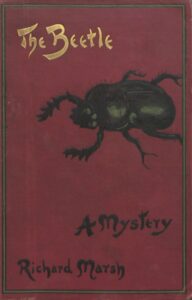
Front Cover for The Beetle – A Mystery | Written by: Richard Marsh, Public domain, via Wikimedia Commons
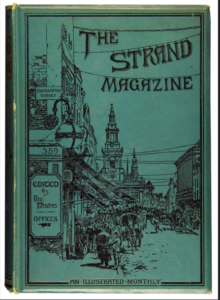
The Strand Magazine | Photo by MichaelMaggs; original artist unknown., Public domain, via Wikimedia Commons
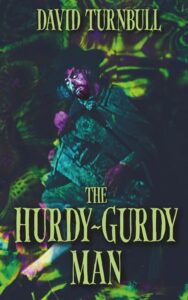
The Hurdy Gurdy Man | Written and Photo by: David Turnbull